History Lessons · From European exploration to 2025
U.S. History
The story of the United States, from the first European voyages to the Americas through 2025: the people, events and ideas that shaped the country, and a profile of every president.
Read the chapters in order, or jump around using the chapter list. Each president has a card in the chapter for their era, and the All the presidents table at the end lists all 47 presidencies. Each chapter ends with a few review questions; press Show answers to check yourself. Tick I've read this chapter to track your progress (saved in this browser only).
Part I · Before the nation
Chapter 1 · To 1607
First peoples and European exploration
The history of the United States doesn't begin with Europeans. People had lived in the Americas for at least 15,000 years before Christopher Columbus crossed the Atlantic, and millions lived in what is now the United States when Europeans arrived. This chapter covers those first peoples, the European voyages that changed their world, and the first attempts at colonies.
The first Americans
Most scientists believe the first people reached the Americas from Asia during the last Ice Age, crossing a land bridge where the Bering Strait is today or traveling down the Pacific coast by boat. Over thousands of years their descendants spread across two continents and built hundreds of distinct societies with their own languages, religions and governments.
Some of these societies were large and complex. Around 1050 to 1350 CE, the city of Cahokia, near present-day St. Louis, may have had 10,000 to 20,000 residents, and its largest earthen mound is still one of the biggest human-made structures in North America. In the Southwest, the Ancestral Puebloans built multistory stone towns at Chaco Canyon and cliff dwellings at Mesa Verde. In the Northeast, five (later six) nations formed the Haudenosaunee, or Iroquois, Confederacy, a political alliance with a council of chiefs that settled disputes among its members.
By 1500, Native peoples farmed corn, beans and squash, fished the coasts and rivers, hunted bison on the Plains, and traded across long distances. Historians estimate that several million people lived north of Mexico, though the exact number is debated.
Early voyages
The first Europeans known to reach North America were the Norse. Around the year 1000, Leif Erikson sailed from Greenland to a place the Norse called Vinland. Archaeologists have confirmed a Norse site at L'Anse aux Meadows in Newfoundland, Canada, but the Norse did not stay, and their visits had little lasting effect.
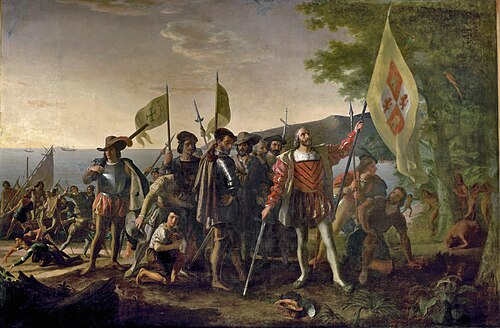
Lasting contact began with Christopher Columbus, an Italian navigator sailing for Spain. He was looking for a western sea route to Asia, and on October 12, 1492, he landed on an island in the Bahamas. The Taíno people living there called it Guanahani. Columbus made four voyages to the Caribbean and never accepted that he had reached lands unknown to Europeans. His arrival led to the enslavement of many Taíno and the collapse of their society within a few decades.
John Vanderlyn's Landing of Columbus (1847) hangs in the U.S. Capitol. Like many paintings of the era, it shows the event the way 19th-century Americans imagined it, not as eyewitnesses saw it. John Vanderlyn. Public domain.
The Columbian Exchange
Columbus's voyages began what historians call the Columbian Exchange: the transfer of plants, animals, people and diseases between the Eastern and Western Hemispheres. Europe gained corn, potatoes, tomatoes and tobacco. The Americas gained horses, cattle, pigs, wheat and sugarcane. The most devastating exports were diseases such as smallpox and measles. Native peoples had no immunity, and epidemics killed a large share of the population, in some places more than half, often before Europeans themselves arrived in an area.
Spain in North America
Spain built the first and largest European empire in the Americas, conquering the Aztec Empire in Mexico (1521) and the Inca Empire in Peru (1532). Spanish explorers also pushed into what is now the United States:
Juan Ponce de León reached Florida in 1513 and gave it its name.
Hernando de Soto led an army through the Southeast from 1539 to 1542 and reached the Mississippi River, spreading violence and disease among the peoples he met.
Francisco Vázquez de Coronado explored the Southwest and southern Plains from 1540 to 1542, searching for legendary cities of gold he never found.
In 1565, Pedro Menéndez de Avilés founded St. Augustine, Florida, the oldest continuously inhabited European-founded city in the continental United States.
In 1598, Juan de Oñate led colonists into New Mexico. Santa Fe was founded around 1610.
Spanish missions and settlements eventually stretched from Florida to California, which is why so many U.S. places have Spanish names.
France and England
France sent Giovanni da Verrazzano along the Atlantic coast in 1524 and Jacques Cartier up the St. Lawrence River in the 1530s. French interest centered on Canada and the fur trade, which depended on trading partnerships with Native nations. Quebec was founded in 1608.
England's first claim came from John Cabot, who reached Newfoundland in 1497. Its first colony in what is now the U.S. was Roanoke, on an island off North Carolina. A 1585 attempt failed, and a second group of about 115 colonists arrived in 1587. Among them was Virginia Dare, the first English child born in the Americas. Supply ships were delayed by war with Spain, and when they returned in 1590, the colony was empty. The only clue was the word "CROATOAN" carved into a post. What happened to the "Lost Colony" is still unknown.
Spotlight: Why Europeans sailed Historians often sum up European motives as "God, gold and glory": spreading Christianity, finding wealth and trade routes, and gaining power over rival nations. In 1494 the Treaty of Tordesillas divided newly found lands between Spain and Portugal, without consulting any of the people who lived there.
c. 13,000 BCEPeople are living in the Americas (some evidence suggests earlier).
c. 1000Norse sailors led by Leif Erikson reach Newfoundland.
c. 1050Cahokia grows into the largest city north of Mexico.
1492Columbus lands in the Bahamas on October 12.
1513Ponce de León reaches and names Florida.
1540–1542Coronado explores the Southwest.
1565St. Augustine, Florida, is founded.
1587English colonists settle Roanoke; by 1590 they have vanished.
Review
What was the Columbian Exchange, and what was its deadliest effect?
What is the oldest continuously inhabited European-founded city in the continental U.S., and who founded it?
Why is Roanoke called the "Lost Colony"?
Show answersHide answers
1. The two-way transfer of plants, animals, people and diseases
After 1492, crops like corn and potatoes went to Europe while horses, cattle and wheat came to the Americas. The deadliest effect was disease: smallpox, measles and other illnesses killed a large share of Native peoples, who had no immunity to them.
2. St. Augustine, Florida, founded by Spain in 1565
Pedro Menéndez de Avilés founded St. Augustine 42 years before the English settled Jamestown. It's a reminder that Spain, not England, was the first European power to build lasting settlements in what became the United States.
3. Its colonists disappeared without a trace
About 115 English colonists settled Roanoke in 1587. When supply ships returned in 1590, delayed by war with Spain, the settlement was deserted, with only the word "CROATOAN" carved into a post. Their fate is still a mystery; many historians think they joined nearby Native communities.
Chapter 2 · 1607–1754
Colonial America
Between 1607 and 1732, England founded thirteen colonies along the Atlantic coast. They grew from struggling outposts into prosperous societies with their own assemblies, churches and economies, built in large part on land taken from Native nations and, increasingly, on the labor of enslaved Africans.
Jamestown: the first permanent English colony
In May 1607, about 100 men and boys sent by the Virginia Company of London founded Jamestown on a swampy river island in Virginia. They hoped to find gold; instead they found disease, hunger and conflict. During the "Starving Time" of 1609–1610, most of the colonists died. The colony survived partly through the leadership of John Smith and trade with the Powhatan Confederacy, whose leader's daughter, Pocahontas, later married colonist John Rolfe.
Rolfe also introduced a sweeter variety of tobacco, which became Virginia's cash crop and its reason to exist. Tobacco needed land and labor, and both drove the colony's future. In 1619 two events shaped American history. In July, the House of Burgesses met, the first elected legislative assembly in English America. In August, a ship brought about 20 Africans to Point Comfort, Virginia, where they were traded for food. They were the first recorded Africans in English North America. Over the following decades, Virginia's laws hardened lifelong, inherited slavery based on race.
Plymouth and New England
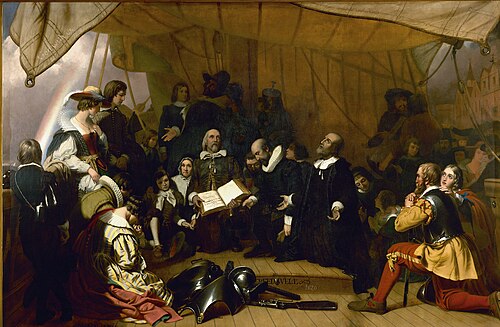
In 1620, the Pilgrims, a group of English Separatists seeking to worship apart from the Church of England, sailed on the Mayflower and landed at Plymouth, Massachusetts. Before going ashore, the men signed the Mayflower Compact, agreeing to make and obey laws for the common good, an early example of self-government. Half the settlers died the first winter. The survivors were helped by the Wampanoag people under their leader Massasoit, and by Tisquantum (Squanto), who spoke English after being kidnapped and taken to Europe years earlier. In the fall of 1621 they shared a harvest celebration later remembered as the first Thanksgiving.
Robert W. Weir's Embarkation of the Pilgrims (1843), in the U.S. Capitol, shows the Pilgrims praying before leaving Holland for America. Robert W. Weir (photograph courtesy Architect of the Capitol). Public domain.
A much larger group of Puritans founded the Massachusetts Bay Colony in 1630. Their governor, John Winthrop, hoped it would be "a city upon a hill," a model Christian community. Puritan leaders tolerated little dissent: Roger Williams was banished and founded Rhode Island in 1636 on the principle of religious freedom, and Anne Hutchinson was expelled for challenging ministers' authority.
Thirteen colonies, three regions
Region
Colonies
Economy and society
New England
Massachusetts, New Hampshire, Connecticut, Rhode Island
Small farms, fishing, shipbuilding and trade; towns built around churches; town meetings
Middle
New York, New Jersey, Pennsylvania, Delaware
Wheat farms ("breadbasket"), busy ports like New York and Philadelphia; the most religious and ethnic diversity
Southern
Maryland, Virginia, North Carolina, South Carolina, Georgia
Plantations growing tobacco, rice and indigo, worked increasingly by enslaved people
New York began as the Dutch colony of New Netherland; England took it in 1664. William Penn, a Quaker, founded Pennsylvania in 1681 as a place of religious tolerance. Maryland (1634) offered refuge to Catholics. Georgia, founded in 1732 by James Oglethorpe, was the last of the thirteen.
Conflict with Native nations
As colonies grew, they pushed onto Native land, and the result was repeated war. In New England, the Pequot War (1636–1638) ended in a massacre of Pequot people, and King Philip's War (1675–1676), led by the Wampanoag leader Metacom (called King Philip by the English), was one of the deadliest wars in American history relative to population. In Virginia, Bacon's Rebellion (1676) began with frontier settlers attacking Native people and ended with them burning Jamestown. Afterward, Virginia's planters relied less on indentured English servants and more on enslaved Africans.
Slavery in the colonies
By the 1700s, slavery was legal in all thirteen colonies, though it was most central in the South. Enslaved Africans were carried across the Atlantic in the brutal Middle Passage, where many died in chained, crowded holds. Colonial "slave codes" denied enslaved people the right to learn to read, travel freely or testify against white people. Enslaved people resisted in many ways, from slowing work to running away to open revolt, as in South Carolina's Stono Rebellion of 1739.
Salem and the Great Awakening
In 1692, accusations of witchcraft spread through Salem, Massachusetts. Before the trials ended, 19 people had been hanged and one man pressed to death with stones. The colony later admitted the trials were a terrible mistake.
In the 1730s and 1740s, a religious revival called the Great Awakening swept the colonies. Preachers like Jonathan Edwards and George Whitefield drew huge crowds with emotional sermons. The revival encouraged people to question established authorities, and some historians see it as a forerunner of revolutionary thinking.
1607Jamestown, Virginia, is founded.
1619The House of Burgesses meets; the first recorded Africans arrive in English Virginia.
1620The Pilgrims sign the Mayflower Compact and found Plymouth.
1630Puritans found the Massachusetts Bay Colony.
1675–1676King Philip's War in New England; Bacon's Rebellion in Virginia.
1692The Salem witch trials.
1732Georgia, the thirteenth colony, is founded.
1739The Stono Rebellion in South Carolina.
Review
Name two events of 1619 in Virginia and explain why each mattered.
What was the Mayflower Compact?
How did the economy of the Southern colonies differ from New England's?
Show answersHide answers
1. The first House of Burgesses, and the arrival of the first recorded Africans
The House of Burgesses was the first elected legislature in English America, a root of American self-government. The same year, about 20 Africans were brought to Virginia and traded for food, the start of the history of African Americans in the English colonies and of the system of slavery that grew there. The two events together capture a contradiction that runs through American history.
2. An agreement by the Plymouth colonists to govern themselves
Signed aboard the Mayflower in 1620, it bound the signers to form a "civil body politic" and obey laws made for the common good. It's often cited as an early example of government based on the consent of the governed.
3. The South relied on plantations and enslaved labor; New England on small farms and trade
Warm weather and rich soil let Southern planters grow tobacco, rice and indigo for export on large plantations that depended more and more on enslaved people. New England's rocky soil and cold winters favored small family farms, fishing, shipbuilding and commerce.
Chapter 3 · 1754–1775
The road to revolution
In 1754, most colonists were proud to be British. Twenty-one years later, colonial militias were firing on British soldiers. This chapter traces how a victorious war, followed by a string of new taxes and laws, turned loyal subjects into rebels.
The French and Indian War
By the 1750s, Britain and France both claimed the Ohio River valley. In 1754 a young Virginia militia officer named George Washington led troops into the region, clashed with French forces and was forced to surrender at Fort Necessity. The fighting grew into the French and Indian War (1754–1763), part of a worldwide conflict between Britain and France known as the Seven Years' War. Most Native nations sided with the French, who were fewer in number and more interested in trade than in taking land.
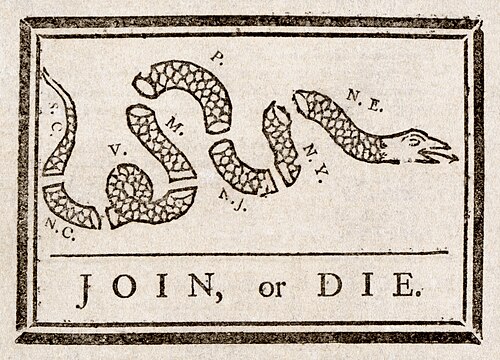
That same year, delegates met at the Albany Congress, where Benjamin Franklin proposed a union of the colonies for common defense. The colonies rejected his Albany Plan, but Franklin's famous cartoon showed the idea that would matter later: unite or perish.
Benjamin Franklin's "Join, or Die" cartoon (1754), one of the first political cartoons in America. Each piece of the snake stands for a colony or region. Benjamin Franklin, 1754-05-09. Public domain.
Britain won. In the Treaty of Paris of 1763, France gave up nearly all its North American territory. But victory left Britain with an enormous war debt and a large new territory to defend.
New rules from London
Britain's leaders decided the colonists should help pay for their own defense, and they began to tighten control:
Proclamation of 1763. After Native nations led by the Odawa leader Pontiac attacked British forts, Britain banned colonial settlement west of the Appalachian Mountains. Colonists who had fought for that land felt cheated.
Sugar Act (1764). A tax on molasses and other imports, with tougher enforcement against smuggling.
Stamp Act (1765). The first direct tax on the colonists, requiring a stamp on newspapers, legal documents, playing cards and more.
The Stamp Act set off a storm. Colonists argued that only their own elected assemblies could tax them, since they had no representatives in Parliament: "No taxation without representation." Nine colonies sent delegates to a Stamp Act Congress, merchants boycotted British goods, and groups called the Sons of Liberty threatened and sometimes attacked tax collectors. Parliament repealed the tax in 1766 but passed the Declaratory Act, insisting it could make laws for the colonies "in all cases whatsoever."
Townshend Acts and the Boston Massacre
The Townshend Acts of 1767 taxed imported glass, paint, paper, lead and tea. Colonists answered with new boycotts; women's groups called the Daughters of Liberty spun homemade cloth so families could avoid British fabric. Britain sent soldiers to Boston to keep order, and tension in the city grew.
On March 5, 1770, a crowd taunted and threw snowballs and rocks at British soldiers guarding the customs house. The soldiers fired, killing five people, among them Crispus Attucks, a sailor of African and Native descent. Patriots called it the Boston Massacre, and Paul Revere's engraving of it spread anger across the colonies. Notably, the soldiers' defense lawyer was John Adams, who believed everyone deserved a fair trial; most were acquitted.
The Boston Tea Party
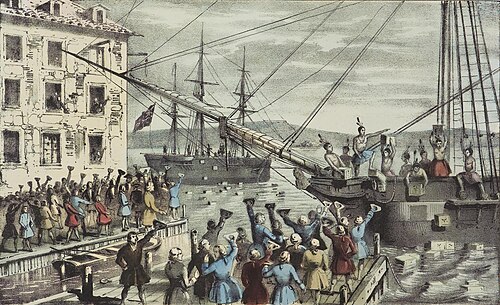
Parliament repealed most of the Townshend taxes but kept the one on tea. The Tea Act of 1773 actually made legal tea cheaper, but it gave the British East India Company a monopoly, and colonists saw it as a trick to make them accept Parliament's right to tax. On the night of December 16, 1773, men disguised as Mohawk Indians boarded three ships in Boston Harbor and dumped 342 chests of tea into the water.
Currier's lithograph The Destruction of Tea at Boston Harbor (1846) shows the Boston Tea Party as later Americans celebrated it. Nathaniel Currier, 1846. Public domain.
The Intolerable Acts and the first shots
Britain responded in 1774 with laws the colonists called the Intolerable Acts. They closed Boston's port until the tea was paid for, put Massachusetts under tighter royal control, and allowed troops to be housed in colonists' buildings. Instead of isolating Boston, the laws united the colonies. In September 1774, twelve colonies sent delegates to the First Continental Congress in Philadelphia, which organized a boycott and urged colonies to train militias.
On the night of April 18, 1775, British troops marched from Boston to seize militia weapons at Concord. Riders including Paul Revere and William Dawes spread the alarm. At dawn on April 19, militiamen faced the British at Lexington; shots were fired and eight colonists were killed. At Concord, militia drove the British back, then harassed them with fire all the way to Boston. The Revolutionary War had begun.
Spotlight: Samuel Adams A Boston politician and organizer, Samuel Adams helped lead the Sons of Liberty and set up Committees of Correspondence, networks that let towns and colonies share news and coordinate resistance. They were one of the most effective tools for turning local anger into a united movement.
1754The French and Indian War begins; the Albany Plan is proposed.
1763The Treaty of Paris ends the war; the Proclamation of 1763 limits western settlement.
1765The Stamp Act; protests and boycotts follow.
1767The Townshend Acts tax imports.
1770The Boston Massacre, March 5.
1773The Boston Tea Party, December 16.
1774The Intolerable Acts; the First Continental Congress meets.
1775Battles of Lexington and Concord, April 19.
Review
Why did Britain begin taxing the colonies after 1763?
What did colonists mean by "No taxation without representation"?
How did the Intolerable Acts backfire on Britain?
Show answersHide answers
1. To pay off the huge debt from the French and Indian War
Britain had won the war but owed enormous sums and now had to defend a much larger territory. Parliament reasoned that the colonists, who had benefited from the victory, should pay part of the cost through new taxes.
2. Only their own elected representatives could tax them
The colonists elected no members of Parliament. They argued that as British subjects they could be taxed only by their own colonial assemblies, so Parliament's taxes violated their rights, no matter how small the taxes were.
3. They united the colonies instead of isolating Massachusetts
Britain meant to punish Boston and warn the other colonies. Instead, other colonies sent food and support to Boston and joined the First Continental Congress, where they coordinated resistance for the first time.
Chapter 4 · 1775–1783
The American Revolution
Thirteen colonies with no army, no navy and no national government took on the most powerful empire in the world, and won. This chapter covers how the colonies declared independence, how they fought the war, and who did and didn't share in the freedom it promised.
From protest to independence
The Second Continental Congress met in May 1775 and named George Washington commander of a new Continental Army. In June, the British won the Battle of Bunker Hill (fought mostly on nearby Breed's Hill) outside Boston, but at such heavy cost that colonists took heart. Even so, many still hoped to make peace with King George III.
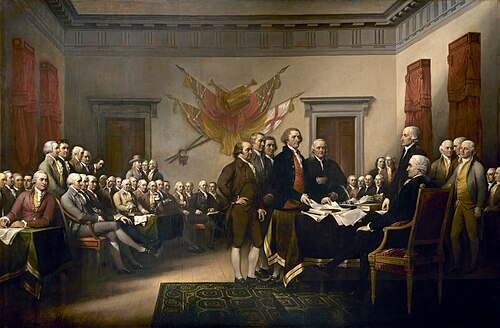
That changed in January 1776, when Thomas Paine published Common Sense, a pamphlet arguing in plain language that it was absurd for an island to rule a continent and that monarchy itself was wrong. It sold well over 100,000 copies in a few months. On July 2, 1776, Congress voted for independence, and on July 4 it adopted the Declaration of Independence, drafted mainly by Thomas Jefferson.
We hold these truths to be self-evident, that all men are created equal, that they are endowed by their Creator with certain unalienable Rights, that among these are Life, Liberty and the pursuit of Happiness.The Declaration of Independence, 1776
The Declaration explained that governments get their power from "the consent of the governed" and listed the colonists' complaints against the king. Its promise of equality would be quoted for centuries by people demanding rights the founders had not granted them.
John Trumbull's Declaration of Independence shows the drafting committee, including Jefferson, Franklin and John Adams, presenting the document to Congress. It appears on the back of the $2 bill. John Trumbull. Public domain.
The war in the North
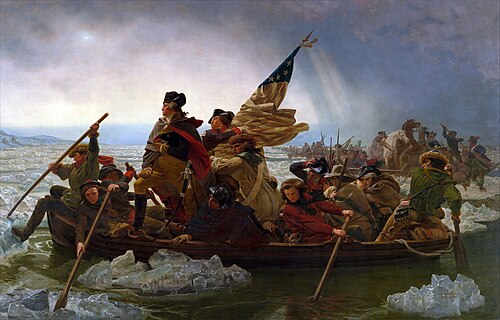
The early war went badly for the Americans. The British captured New York City in 1776, and Washington's army retreated across New Jersey. Then, on the night of December 25, 1776, Washington led his troops across the icy Delaware River and surprised Hessian soldiers (German troops hired by Britain) at Trenton. The small victory, followed by another at Princeton, saved the army's morale.
Emanuel Leutze's Washington Crossing the Delaware (1851) is one of the most famous American paintings, though it takes liberties: the real crossing happened at night, in sleet, in larger boats. Emanuel Leutze. Public domain.
The turning point came in October 1777, when American forces defeated and captured a British army under General John Burgoyne at Saratoga, New York. The victory convinced France that the Americans could win. In February 1778, France signed a treaty of alliance, bringing money, soldiers and, crucially, a navy. Spain and the Netherlands later joined the war against Britain too.
Meanwhile, Washington's army spent the brutal winter of 1777–1778 at Valley Forge, Pennsylvania, where perhaps 2,000 soldiers died of disease and exposure. A Prussian officer, Baron Friedrich von Steuben, drilled the survivors into a far more disciplined fighting force.
The war in the South and victory
After 1778 the British shifted to the South, hoping Loyalists there would rise to help them. They captured Savannah and Charleston, but American forces under Nathanael Greene wore them down. In 1781, British general Charles Cornwallis moved his army to Yorktown, Virginia, on the coast. A French fleet blocked his escape by sea while American and French troops under Washington and the Comte de Rochambeau surrounded him on land. Cornwallis surrendered on October 19, 1781. Fighting continued in places, but Britain had lost the will to go on. In the Treaty of Paris, signed September 3, 1783, Britain recognized American independence, with a western border at the Mississippi River.
Who fought, and who was left out
Loyalists. Perhaps 15 to 20 percent of colonists stayed loyal to Britain. Tens of thousands fled after the war, many to Canada.
African Americans fought on both sides. Around 5,000 or more served with the Patriots. Many more enslaved people escaped to the British, who in 1775 promised freedom to those who joined them (Lord Dunmore's Proclamation). Several Northern states began to end slavery during or soon after the war, but in the South it remained.
Women ran farms and businesses, raised money, followed the army as cooks and nurses, and a few, like Deborah Sampson, disguised themselves as men to fight. In 1776 Abigail Adams wrote to her husband John urging Congress to "remember the ladies," but women gained no new political rights.
Native nations mostly sided with Britain, which had tried to limit colonial expansion. The Haudenosaunee Confederacy split, with nations fighting on opposite sides. The peace treaty ignored Native nations entirely, and American settlers soon poured west.
1775Washington takes command; the Battle of Bunker Hill, June 17.
1776Paine's Common Sense in January; the Declaration of Independence, July 4; Trenton, December 26.
1777American victory at Saratoga, October.
1777–1778Winter at Valley Forge.
1778France allies with the United States.
1781Cornwallis surrenders at Yorktown, October 19.
1783The Treaty of Paris recognizes independence.
Review
Why is the Battle of Saratoga called the turning point of the war?
What did the Declaration of Independence say is the source of a government's power?
Why did many enslaved African Americans side with the British?
Show answersHide answers
1. It brought France into the war on the American side
Capturing an entire British army in 1777 proved the Americans could win. France signed an alliance in early 1778, supplying money, troops and a navy. French ships later trapped Cornwallis at Yorktown, which effectively ended the war.
2. The consent of the governed
The Declaration says governments are created to protect people's rights and get their "just powers from the consent of the governed." When a government destroys those rights, the people may change or abolish it. That reasoning justified breaking with the king.
3. The British promised them freedom
In 1775 Virginia's royal governor, Lord Dunmore, offered freedom to enslaved people who escaped Patriot owners and joined British forces, and later British commanders made similar offers. For many enslaved people, the British side offered a more direct path to liberty than the Patriot cause did.
Chapter 5 · 1783–1800
A new republic
Winning independence was one challenge; building a working country was another. In less than twenty years, Americans wrote two plans of government, threw out the first, launched the second under George Washington, and peacefully handed power from one political party to another.
The Articles of Confederation
The first national government operated under the Articles of Confederation, ratified in 1781. Fearing a powerful central government like the one they had just escaped, the authors made it very weak. There was no president and no national courts, only a one-house Congress in which each state had one vote. Congress could not tax, could not regulate trade between states, and needed nine of thirteen states to pass major laws and all thirteen to amend the Articles.
Congress did achieve one lasting success: the Northwest Ordinance of 1787, which set up a process for territories north of the Ohio River to become equal states and banned slavery there. But the government couldn't pay its debts or its soldiers. In 1786–1787, debt-ridden farmers in western Massachusetts, led by Revolutionary veteran Daniel Shays, closed courts to stop foreclosures on their farms. Shays' Rebellion was put down by a privately funded state militia, and it convinced many leaders that the nation needed a stronger government.
The Constitutional Convention
In May 1787, delegates from twelve states (Rhode Island refused to come) met in Philadelphia, officially to revise the Articles. Instead, meeting in secret, they wrote an entirely new Constitution. Washington presided, and James Madison, later called the "Father of the Constitution," shaped much of the plan. Delegates resolved their disagreements through compromises:
The Great Compromise (or Connecticut Compromise): large states wanted representation by population (the Virginia Plan); small states wanted equal votes (the New Jersey Plan). The answer was a two-house Congress: a House of Representatives based on population and a Senate with two members per state.
The Three-Fifths Compromise: Southern states wanted enslaved people counted toward their population for House seats, though not given rights. The convention agreed to count each enslaved person as three-fifths of a person, which gave slaveholding states extra power in Congress and in choosing presidents.
The slave trade: Congress could not ban the importation of enslaved people before 1808. It did so as soon as it was allowed, though slavery itself continued.
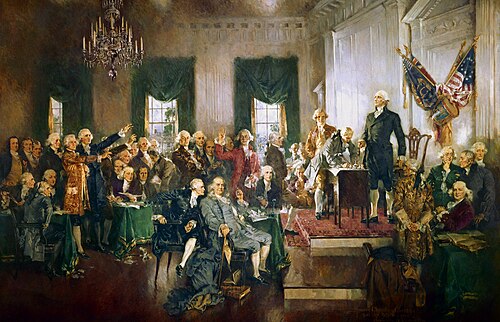
The Constitution divided power among three branches (legislative, executive and judicial), each able to check the others, and between the national government and the states, a system called federalism. Thirty-nine delegates signed it on September 17, 1787.
Howard Chandler Christy's Scene at the Signing of the Constitution of the United States (1940), in the U.S. Capitol. Howard Chandler Christy. Public domain.
Ratification and the Bill of Rights
Nine states had to ratify the Constitution. Supporters, called Federalists, made their case in 85 newspaper essays by Alexander Hamilton, James Madison and John Jay, now known as The Federalist Papers. Opponents, the Anti-Federalists, feared a strong government would trample individual liberty and pointed out that the Constitution had no list of rights. New Hampshire became the ninth state to ratify in June 1788, putting the Constitution into effect. To win over doubters, Federalists promised amendments, and the first ten, the Bill of Rights, were ratified in December 1791. They protect freedom of speech, religion, the press and assembly, the right to bear arms, and the rights of people accused of crimes, among others.
The first parties
The founders distrusted political parties, but they formed almost at once. Treasury Secretary Alexander Hamilton wanted a strong national government, a national bank and an economy built on trade and manufacturing; his supporters became the Federalists. Secretary of State Thomas Jefferson and James Madison feared concentrated power and favored states' rights and a nation of farmers; their followers became the Democratic-Republicans. The two sides also split over the French Revolution, which Jefferson's side admired and Hamilton's distrusted.
1George Washington
1st president · 1789–1797 · No party
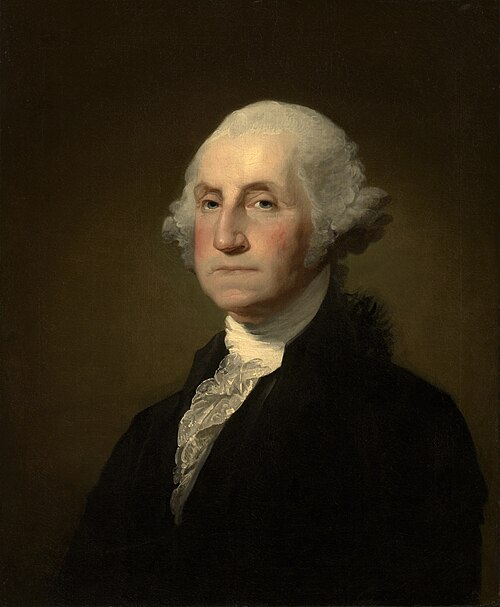
The commander who won the Revolution was elected unanimously, twice, by the Electoral College, and took the oath on April 30, 1789, in New York City, the first capital. Washington set countless precedents: forming a cabinet of department heads, being addressed simply as "Mr. President," and using federal troops to put down the Whiskey Rebellion (1794), a revolt by Pennsylvania farmers against a tax on whiskey. He kept the country neutral in the war between Britain and France and signed the unpopular Jay Treaty (1795) with Britain to avoid war. He stepped down after two terms, setting a two-term tradition that lasted until 1940. His Farewell Address warned against political parties and permanent foreign alliances. Washington owned enslaved people throughout his life; his will freed them after his wife Martha's death.
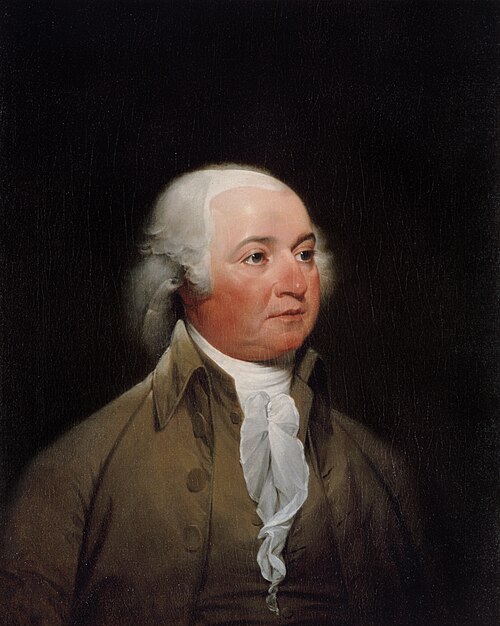
2John Adams
2nd president · 1797–1801 · Federalist
A leader of the independence movement and Washington's vice president, Adams narrowly defeated Jefferson in 1796. His presidency was dominated by conflict with France: after French officials demanded bribes from American diplomats in the XYZ Affair, the two nations fought an undeclared naval "Quasi-War." Adams resisted pressure for a full war and eventually negotiated peace, a choice he considered his proudest act. But he also signed the Alien and Sedition Acts (1798), which made it a crime to publish "false, scandalous and malicious" writing against the government and were used to jail Republican newspaper editors. Jefferson and Madison answered with the Kentucky and Virginia Resolutions, arguing states could reject unconstitutional laws. Adams was the first president to live in the White House, and his loss to Jefferson in 1800 led to the first peaceful transfer of power between rival parties.
1781The Articles of Confederation take effect.
1786–1787Shays' Rebellion in Massachusetts.
1787The Northwest Ordinance; the Constitution is signed September 17.
1788New Hampshire becomes the ninth state to ratify the Constitution.
1789Washington is inaugurated April 30.
1791The Bill of Rights is ratified.
1798The Alien and Sedition Acts.
1800Jefferson defeats Adams: the first transfer of power between parties.
Review
Name two weaknesses of the Articles of Confederation.
What did the Great Compromise decide?
Why was the election of 1800 important?
Show answersHide answers
1. Congress couldn't tax or regulate trade, and there was no executive or national court
Without the power to tax, the government couldn't pay its debts or soldiers, and without power over trade, states fought economic battles with each other. Amending the Articles required all thirteen states, so fixing these problems was nearly impossible. Shays' Rebellion made the weakness impossible to ignore.
2. Congress would have two houses
Representation in the House would be based on population, which pleased large states, while every state would get two senators, which protected small states. That structure still shapes American politics today.
3. Power passed peacefully from one party to its rival
The Federalist Adams lost to the Democratic-Republican Jefferson and left office without violence, even though the two parties distrusted each other deeply. Jefferson called it the "Revolution of 1800." Peaceful transfers of power became a cornerstone of American democracy.
Part II · A growing nation
Chapter 6 · 1801–1837
From Jefferson to Jackson
In 1800 the United States was a string of coastal states with about five million people. By 1837 it stretched past the Mississippi River, had fought a second war with Britain, and had a new style of mass politics built around ordinary voters. It had also forced tens of thousands of Native Americans from their homelands. This chapter follows those changes through five presidencies.
The "Revolution of 1800"
The election of 1800 was bitter. Thomas Jefferson's Democratic-Republicans, who favored states' rights, farmers and a small federal government, defeated John Adams's Federalists. When Adams handed over power peacefully, it proved that the presidency could change parties without violence, something many people around the world doubted a republic could do. Jefferson called his victory a "revolution," though in practice he kept much of what the Federalists had built.
The Louisiana Purchase and Lewis and Clark
In 1803 France, under Napoleon, offered to sell the vast Louisiana Territory: about 828,000 square miles between the Mississippi River and the Rocky Mountains. The price was $15 million, roughly three cents an acre. Jefferson worried that the Constitution didn't clearly allow the government to buy land, but he took the deal, and it doubled the size of the country overnight. The land was French only on paper; it was home to many Native nations who had never been consulted.
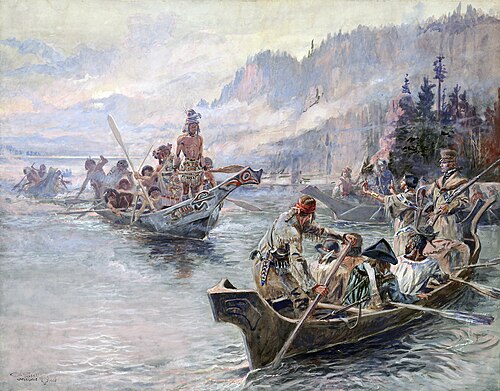
Jefferson sent Meriwether Lewis and William Clark to explore it. Their Corps of Discovery left near St. Louis in 1804, reached the Pacific coast in 1805 and returned in 1806. They were helped at key moments by Sacagawea, a Lemhi Shoshone woman who traveled with them with her infant son. She served as an interpreter, and her presence signaled to Native peoples that the group was not a war party.
Lewis and Clark on the Lower Columbia, painted by Charles M. Russell in 1905. Sacagawea is shown at the front of the boat. Charles Marion Russell, 1905. Public domain.
The Supreme Court finds its power
In Marbury v. Madison (1803), Chief Justice John Marshall ruled that the Supreme Court can strike down a law that conflicts with the Constitution. This power, called judicial review, isn't spelled out in the Constitution, but since Marshall's ruling it has made the Court an equal branch of government.
The War of 1812
Britain and France were at war, and both interfered with American shipping. The British Navy also stopped American ships and forced thousands of sailors into its service, a practice called impressment. On the frontier, Americans blamed Britain for supporting Native resistance led by the Shawnee leader Tecumseh, who was trying to unite tribes against American expansion. In 1812, President Madison asked Congress to declare war.
The war went poorly at first. An American invasion of Canada failed, and in August 1814 British troops captured Washington and burned the White House and the Capitol. Weeks later, the failed British attack on Fort McHenry in Baltimore inspired Francis Scott Key to write "The Star-Spangled Banner." The Treaty of Ghent ended the war in December 1814 with no change in borders. News traveled slowly, so the biggest American victory, Andrew Jackson's defense of New Orleans in January 1815, came after the peace was signed. Many Americans still felt they had won a "second war of independence." Native nations were the real losers: Tecumseh was killed in 1813, and with Britain gone as an ally, their resistance in the Ohio Valley collapsed.
Good feelings and growing divisions
After the war, the Federalist Party faded, and James Monroe's presidency became known as the Era of Good Feelings. Roads, canals and, later, railroads tied the country together. New York's Erie Canal, finished in 1825, connected the Great Lakes to the Atlantic and turned New York City into the nation's leading port.
Underneath, slavery was splitting the country. When Missouri asked to join as a slave state in 1819, Northerners objected that it would tip the balance in the Senate. The Missouri Compromise of 1820 admitted Missouri as a slave state and Maine as a free state, and banned slavery in the rest of the Louisiana Territory north of the 36°30′ line. Jefferson, then retired, wrote that the crisis woke him "like a fire bell in the night."
In foreign policy, the Monroe Doctrine (1823) warned European powers not to create new colonies or interfere in the Western Hemisphere, where most of Latin America had just won independence from Spain. The U.S. couldn't enforce it at the time, but it became a lasting principle of American foreign policy.
Jacksonian democracy
By the 1820s most states had dropped property requirements, so nearly all white men could vote. Women, enslaved people and most free Black men could not. In 1824 Andrew Jackson won the most popular and electoral votes but not a majority, so the House of Representatives chose John Quincy Adams. Jackson's supporters called it a "corrupt bargain" when Adams named Henry Clay, who had backed him in the House, as secretary of state. Jackson won easily in 1828, and his followers organized the Democratic Party; his opponents became the Whigs.
Jackson presented himself as the champion of the common man against wealthy elites. He vetoed the renewal of the Second Bank of the United States, calling it a tool of the rich. When South Carolina claimed it could "nullify," or ignore, a federal tariff, he threatened to use force, and the state backed down after a compromise tariff.
Indian removal
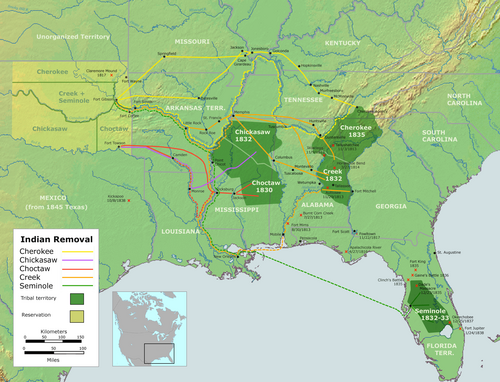
The darkest part of the era was the forced removal of Native nations from the Southeast. Cherokee, Muscogee (Creek), Chickasaw, Choctaw and Seminole people lived on land that white settlers and cotton planters wanted. Many Cherokee had adopted a written language, a constitution and farms much like their neighbors', but that didn't protect them. The Indian Removal Act of 1830 authorized the president to trade land west of the Mississippi for Native lands in the East. In Worcester v. Georgia (1832), the Supreme Court ruled that Georgia had no authority over Cherokee land, but Jackson refused to enforce the decision. Over the following decade, about 60,000 people were forced west. The Cherokee removal of 1838–39, carried out under Jackson's successor, became known as the Trail of Tears; an estimated 4,000 Cherokee died along the way. (See Chapter 7.)
1800Jefferson defeats Adams; the first peaceful transfer of power between parties.
1803Louisiana Purchase; Marbury v. Madison establishes judicial review.
1804–06Lewis and Clark's expedition to the Pacific and back.
1812–15War of 1812; Washington burned in 1814; Battle of New Orleans in 1815.
1820Missouri Compromise.
1823Monroe Doctrine.
1825Erie Canal opens.
1830Indian Removal Act.
1832Jackson vetoes the Bank; nullification crisis begins.
The presidents of this era
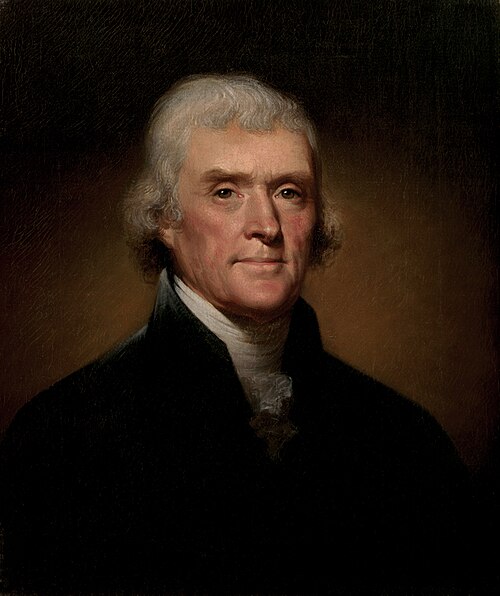
3Thomas Jefferson
3rd president · 1801–1809 · Democratic-Republican
The author of the Declaration of Independence, Jefferson believed the country's future lay with independent farmers and a limited federal government. As president he cut the national debt, bought the Louisiana Territory and sent Lewis and Clark west. His Embargo Act of 1807, which halted trade with Europe to avoid war, badly hurt the American economy. Jefferson wrote that "all men are created equal" yet enslaved more than 600 people over his lifetime, and historians generally accept that he fathered children with one of them, Sally Hemings.
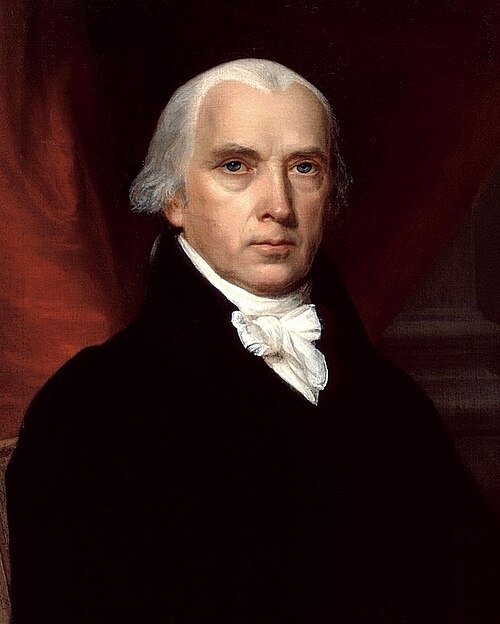
4James Madison
4th president · 1809–1817 · Democratic-Republican
Called the "Father of the Constitution" for his role at the 1787 convention, Madison also drafted the Bill of Rights. As president he led the country into the War of 1812 and had to flee Washington when the British burned it; his wife, Dolley Madison, famously had a portrait of George Washington saved from the White House. The war's end left the country more confident and united.
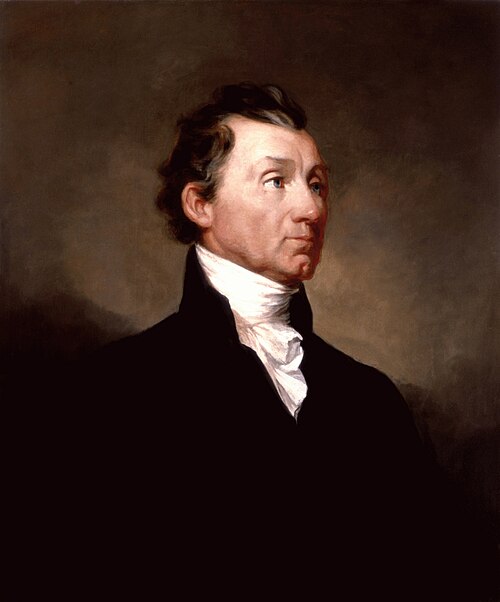
5James Monroe
5th president · 1817–1825 · Democratic-Republican
A Revolutionary War veteran wounded at the Battle of Trenton, Monroe presided over the Era of Good Feelings, when one party dominated politics. He signed the Missouri Compromise and issued the Monroe Doctrine. He ran unopposed for reelection in 1820.
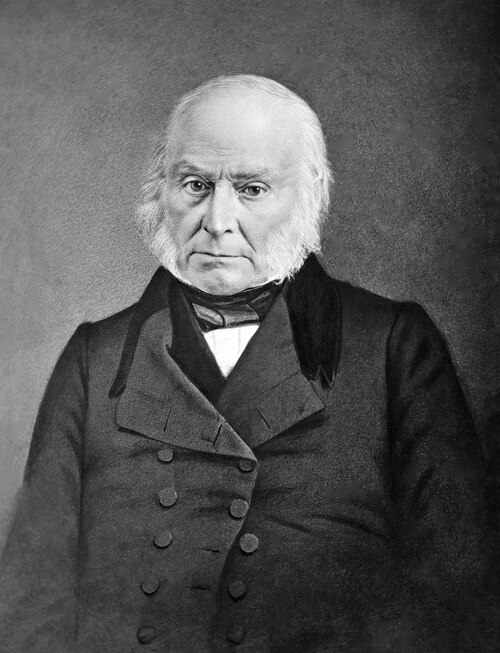
6John Quincy Adams
6th president · 1825–1829 · Democratic-Republican (later National Republican)
The son of John Adams, he was one of the most skilled diplomats in American history and the main author of the Monroe Doctrine. His presidency was frustrated by the "corrupt bargain" charge and a hostile Congress, which rejected his plans for national roads, canals and a national university. After losing to Jackson, he served 17 years in the House of Representatives, where he fought rules that blocked debate on slavery. In 1841 he argued before the Supreme Court for the freedom of the Africans who had taken over the slave ship Amistad, and won.
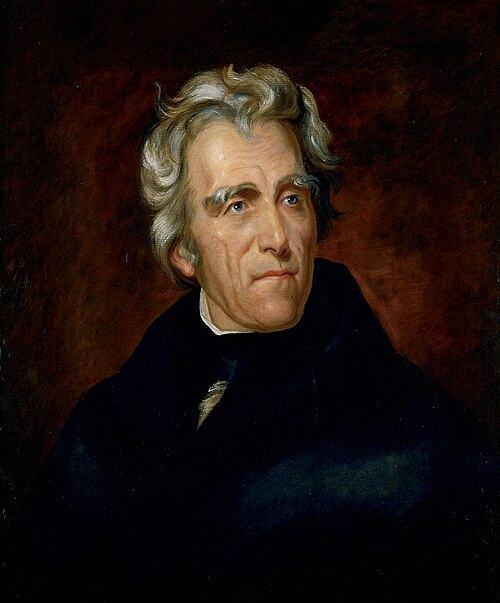
7Andrew Jackson
7th president · 1829–1837 · Democratic
A frontier general and the hero of New Orleans, Jackson was the first president from outside the Virginia and Massachusetts elite. He expanded presidential power, rewarded supporters with government jobs (the "spoils system"), destroyed the Second Bank of the United States and faced down South Carolina's attempt at nullification. He also signed the Indian Removal Act and pushed it forward despite the Supreme Court. Jackson enslaved about 150 people. Admirers celebrated him as a champion of democracy; critics called him "King Andrew."
Check your understanding
Why did Jefferson hesitate before buying Louisiana, and why did he go ahead?
What did the Missouri Compromise do?
What happened after the Supreme Court ruled for the Cherokee in Worcester v. Georgia?
Show answersHide answers
1. The Constitution didn't clearly allow it, but the deal was too good to pass up
Jefferson believed in reading the Constitution strictly, and it says nothing about buying land from a foreign country. But the purchase doubled the nation's size for about three cents an acre and gave the U.S. control of the Mississippi River and New Orleans, which western farmers depended on to ship their crops. He decided the opportunity outweighed his doubts.
2. It balanced slave and free states and drew a line for future ones
Missouri entered as a slave state and Maine as a free state, keeping the Senate evenly divided. Slavery was banned in the rest of the Louisiana Territory north of latitude 36°30′. It calmed the crisis for about 30 years, until new territory from the Mexican-American War reopened the question.
3. Jackson and Georgia ignored the ruling, and removal went ahead
The Court said Georgia had no authority over Cherokee land, but the Court has no army to enforce its decisions; that's the president's job. Jackson refused to act, and the federal government went on to carry out removal under the Indian Removal Act. The result was the Trail of Tears in 1838–39.
Chapter 7 · 1837–1850
Expansion and reform
In just over a decade, the United States grew by more than a million square miles and reached the Pacific. Americans also argued fiercely about what kind of country it should be: reformers campaigned against alcohol, for public schools, for women's rights and, most explosively, against slavery. The two stories were tied together, because every new territory raised the same question: would slavery be allowed there?
Hard times and the Trail of Tears
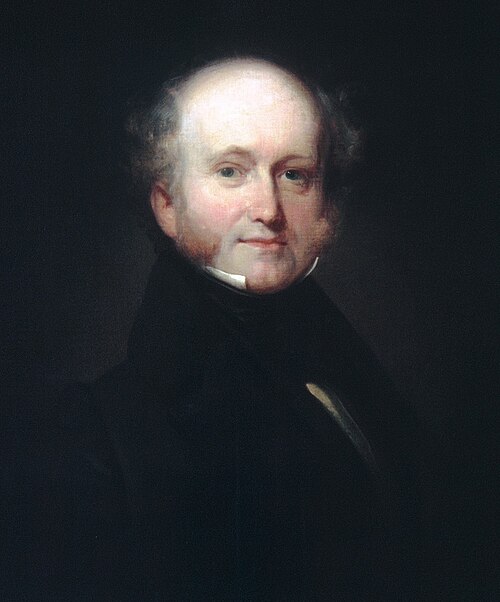
Martin Van Buren took office just as the Panic of 1837 hit. Banks failed, prices collapsed and unemployment soared in a depression that lasted about five years. It cost Van Buren reelection.
His administration also carried out the removal of the Cherokee Nation. Most Cherokee had refused to leave under a treaty signed in 1835 by a small faction without the nation's approval. In 1838 federal troops rounded up about 16,000 people, held them in camps, and marched them roughly 1,000 miles to Indian Territory in present-day Oklahoma, much of the way through winter. Disease, cold and hunger killed an estimated 4,000. The Cherokee called the journey Nunna daul Isunyi, "the trail where we cried."
Routes of the forced removals of the Southeastern nations to Indian Territory (present-day Oklahoma), 1830s. Map by Wikimedia Commons user Nikater. Public domain.
Manifest Destiny
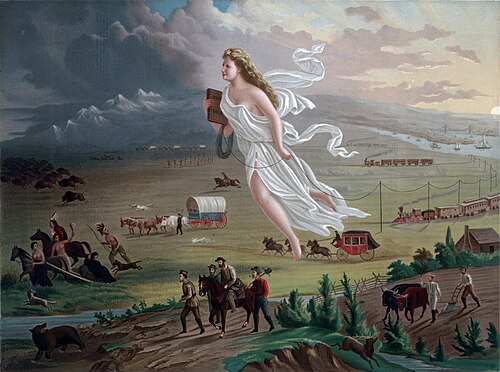
In 1845 the editor John O'Sullivan wrote that it was America's "manifest destiny to overspread the continent." The phrase captured a widespread belief that the United States was meant to expand from coast to coast, carrying democracy and Protestant Christianity with it. It ignored, or justified pushing aside, the Native nations and Mexican citizens who already lived in the West.
John Gast's American Progress (1872) shows Manifest Destiny as the painter's admirers saw it: a figure of "Progress" leads settlers, railroads and telegraph lines west while Native Americans and buffalo are driven out of the frame. John Gast, 1872. Public domain.
Texas, Oregon and war with Mexico
Americans had moved into Mexican Texas in large numbers, many bringing enslaved people even though Mexico had abolished slavery in 1829. In 1836 Texans revolted. After Mexican forces under Santa Anna overwhelmed the defenders of the Alamo, Texans won at San Jacinto and declared an independent republic. Because Texas would enter as a slave state, annexation was controversial for nearly a decade, until Congress approved it in 1845.
President James K. Polk campaigned on expansion. In 1846 he settled the Oregon dispute with Britain peacefully, dividing it at the 49th parallel. Mexico was another matter. Polk sent troops into land between the Nueces River and the Rio Grande that both countries claimed, and when a clash followed he told Congress that Mexico had "shed American blood upon the American soil." Many Americans disagreed: a young congressman named Abraham Lincoln demanded to know the exact "spot" where it happened, and the writer Henry David Thoreau went to jail rather than pay taxes to support the war.
American forces won a series of battles and captured Mexico City in 1847. The Treaty of Guadalupe Hidalgo (1848) gave the United States what is now California, Nevada and Utah, most of Arizona and New Mexico, and parts of Colorado and Wyoming, along with Mexico's recognition of the Rio Grande border of Texas. The U.S. paid $15 million. About half of Mexico's territory was gone. Roughly 80,000 to 100,000 Mexicans living there suddenly found themselves inside the United States; the treaty promised to protect their property, but many lost their land in the following decades.
The war reopened the slavery question. Congressman David Wilmot proposed banning slavery in any land won from Mexico. His Wilmot Proviso never passed, but the fight over it split Congress along North–South lines rather than party lines.
An age of reform
A religious revival known as the Second Great Awakening swept the country in the early 1800s, inspiring many Americans to try to perfect society. Reformers campaigned against heavy drinking (the temperance movement), for free public schools (led by Horace Mann in Massachusetts) and for humane care of the mentally ill (led by Dorothea Dix).
Women were active in all these causes, and many began to demand rights for themselves. In 1848 about 300 people met at Seneca Falls, New York, for the first women's rights convention. Organized by Elizabeth Cady Stanton and Lucretia Mott, it adopted a Declaration of Sentiments modeled on the Declaration of Independence: "We hold these truths to be self-evident: that all men and women are created equal." Its call for women's right to vote was so radical that it barely passed. Frederick Douglass spoke in its favor.
The fight against slavery
By 1850 about 3.2 million people were enslaved in the United States, almost all in the South, where cotton grown by enslaved workers was the country's most valuable export. In 1831 William Lloyd Garrison began publishing The Liberator, demanding immediate abolition. The same year, Nat Turner led a rebellion in Virginia that killed about 60 white people; in response, Southern states passed harsher laws against teaching enslaved people to read or letting them gather.
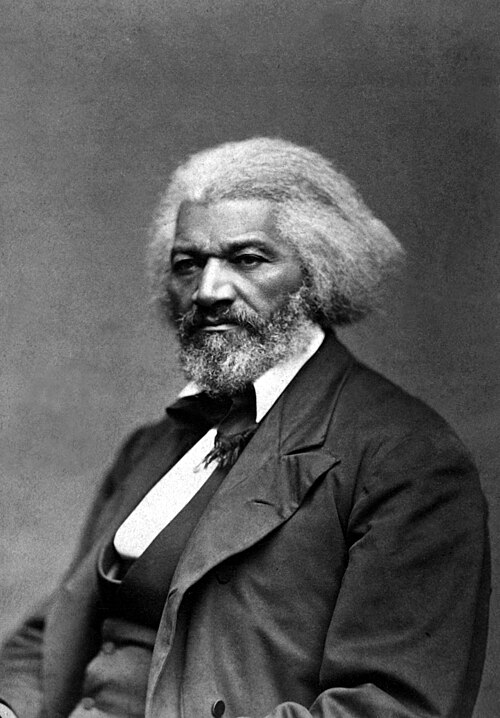
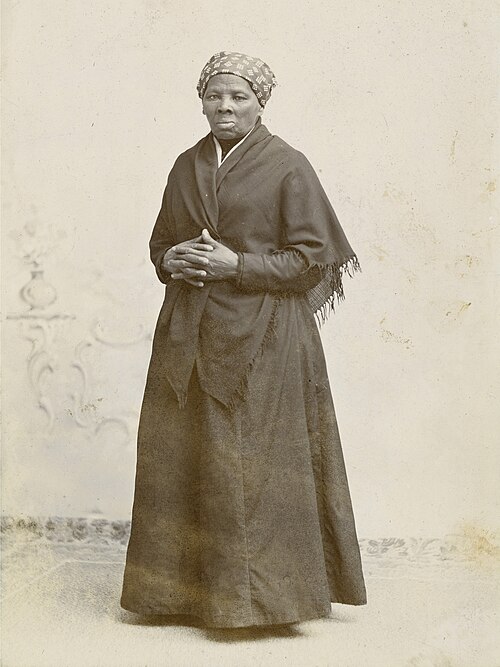
Formerly enslaved people became the movement's most powerful voices. Frederick Douglass escaped from Maryland in 1838 and published his autobiography in 1845; he became one of the great speakers and writers of the century. Harriet Tubman escaped in 1849 and returned to Maryland about 13 times to lead roughly 70 people to freedom on the Underground Railroad, a network of people and safe houses that helped freedom seekers reach the North and Canada.
Frederick Douglass, about 1879. He was the most photographed American of the 19th century, and chose to be pictured with dignity to counter racist caricatures. George Kendall Warren, circa 1879. Public domain.Harriet Tubman, about 1885. During the Civil War she also served as a Union scout and spy. Horatio Seymour Squyer, circa 1885. Public domain.
Gold!
In January 1848, days before the war with Mexico officially ended, gold was found at Sutter's Mill in California. About 300,000 people rushed in from across the country and around the world, including Chile, Mexico and China. California's non-Native population exploded, and it applied to join the Union as a free state in 1849. For California's Native peoples the Gold Rush was a catastrophe: their population fell from roughly 150,000 to about 30,000 by 1870 through disease, starvation and killings, some of them paid for by the state.
1836Texas revolution; the Alamo and San Jacinto.
1837Panic of 1837 begins a long depression.
1838–39The Cherokee Trail of Tears.
1845Texas annexed; "Manifest Destiny" coined; Douglass publishes his Narrative.
1846Oregon divided with Britain; war with Mexico begins.
1848Treaty of Guadalupe Hidalgo; Seneca Falls Convention; gold found in California.
1849Gold Rush; Harriet Tubman escapes slavery.
The presidents of this era
8Martin Van Buren
8th president · 1837–1841 · Democratic
A New York political organizer who helped build the Democratic Party, Van Buren was the first president born a citizen of the United States rather than a British subject. His term was overwhelmed by the Panic of 1837, and his administration carried out the Cherokee removal. In 1848 he ran again for president on the antislavery Free Soil ticket.
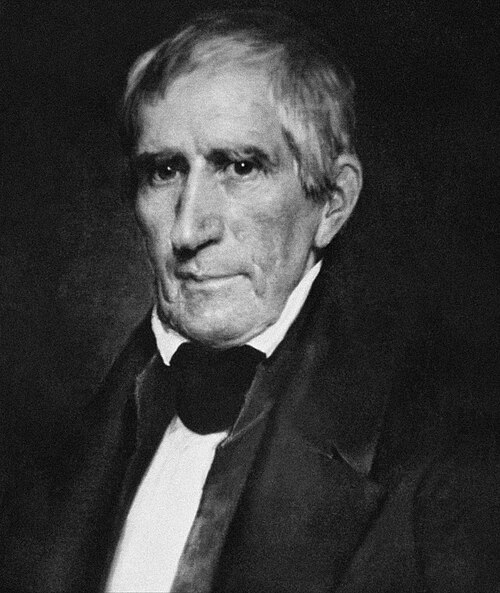
9William Henry Harrison
9th president · 1841 · Whig
A general famous for defeating Tecumseh's confederacy at Tippecanoe in 1811, Harrison won with the slogan "Tippecanoe and Tyler too" in one of the first modern campaigns, full of songs, rallies and souvenirs. He gave the longest inaugural address in history and died of illness 31 days later, the shortest presidency ever.
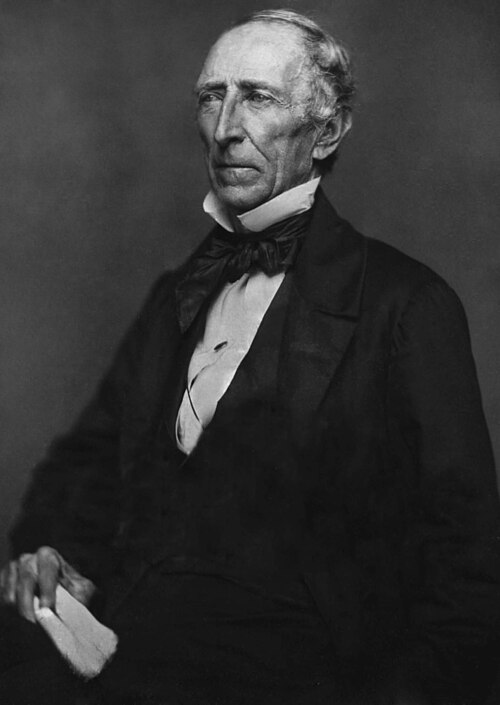
10John Tyler
10th president · 1841–1845 · Whig (expelled from the party in 1841)
The first vice president to take over after a president's death, Tyler insisted he was fully president, not an "acting" one, setting a precedent that lasted until the 25th Amendment made it official. He vetoed much of his own party's program and the Whigs threw him out. In his last days in office he signed the annexation of Texas. He later sided with the Confederacy and was elected to its congress.
11James K. Polk
11th president · 1845–1849 · Democratic
Polk promised to serve one term and kept the promise, achieving nearly every goal he set: lower tariffs, an independent treasury, Oregon, and California. The Mexican-American War added about 525,000 square miles of territory, but critics then and since have seen it as a war of conquest. He left office worn out and died three months later.
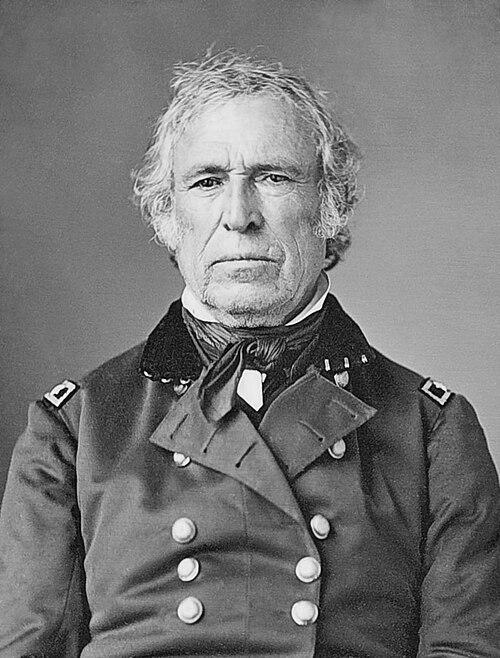
12Zachary Taylor
12th president · 1849–1850 · Whig
A career soldier and hero of the Mexican-American War, Taylor had never voted before running for president. Though he enslaved people himself, he wanted California and New Mexico admitted as free states and threatened to hang anyone who tried to break up the Union. He died suddenly in July 1850, after 16 months in office, while Congress was still fighting over the territories.
Check your understanding
What was Manifest Destiny, and who paid the price for it?
Why did the Mexican-American War make the slavery debate worse?
What did the Seneca Falls Convention demand that shocked even many of its supporters?
Show answersHide answers
1. The belief that the U.S. was destined to spread across the continent
The phrase was coined in 1845, but the idea drove American expansion throughout the 1800s. It treated the West as empty land waiting for settlers, when in fact it was home to many Native nations and, in the Southwest, to Mexican citizens. Both groups lost land, and many lost their lives, as the country expanded.
2. It added huge new territory, and no one agreed whether slavery would be allowed there
The Missouri Compromise line only covered the Louisiana Purchase. The land won from Mexico raised the question all over again, and the Wilmot Proviso fight showed that Northerners and Southerners would vote by region rather than by party. That split set up the crises of the 1850s.
3. The right of women to vote
The Declaration of Sentiments listed many injustices, from property laws to education. The resolution calling for women's suffrage was the only one that didn't pass unanimously; Frederick Douglass's support helped it pass. Women wouldn't win the national vote until the 19th Amendment in 1920, 72 years later.
Chapter 8 · 1850–1861
The road to civil war
In 1850 Congress patched over the fight about slavery in the new territories with one more compromise. Within eleven years the patch had failed completely. A series of laws, court rulings, books and acts of violence convinced many Northerners that slaveholders controlled the national government, and convinced many white Southerners that the North meant to destroy slavery and their way of life. When Abraham Lincoln won the presidency in 1860, Southern states began to leave the Union.
The Compromise of 1850
California's request to join as a free state would have given free states a majority in the Senate. After months of debate, led by the aging senators Henry Clay, Daniel Webster and John C. Calhoun and the younger Stephen Douglas, Congress passed a package of five laws:
California entered the Union as a free state.
The New Mexico and Utah territories would decide about slavery for themselves, an idea called popular sovereignty.
The slave trade (but not slavery) was banned in Washington, D.C.
Texas gave up its claim to part of New Mexico in exchange for the federal government paying its debts.
A much stronger Fugitive Slave Act was passed.
The Fugitive Slave Act did the most damage. It required citizens in free states to help catch people who had escaped slavery, and it denied the accused a jury trial or the right to testify. Federal commissioners were even paid more for sending someone back to slavery than for setting them free. Free Black people in the North could be kidnapped and sold south, and thousands fled to Canada. Northerners who had never cared much about slavery now saw it reaching into their own towns, and some crowds broke accused people out of jail.
The book that moved a nation
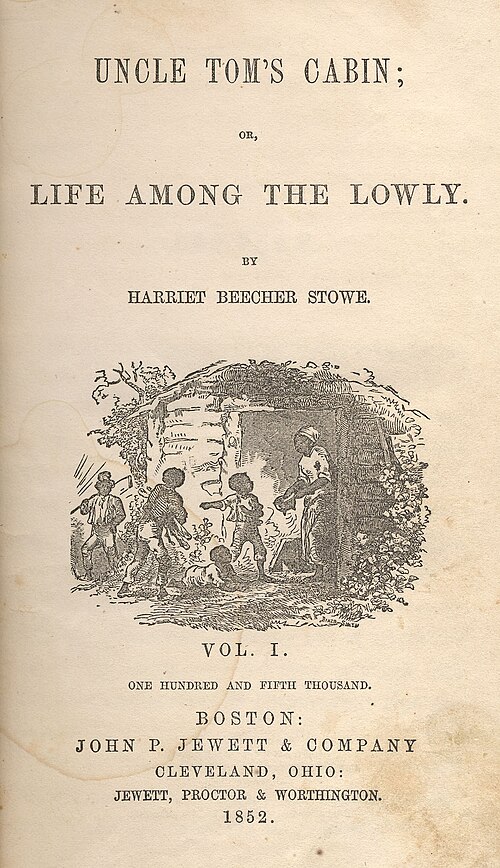
Harriet Beecher Stowe's novel Uncle Tom's Cabin (1852) told the story of enslaved families torn apart by sale. It sold about 300,000 copies in its first year in the U.S. and was the best-selling novel of the 19th century. It made millions of Northern readers feel slavery's cruelty personally; in the South it was denounced as lies and banned in some places.
The title page of the first edition of Uncle Tom's Cabin, 1852. Hammatt Billings, 1852. Public domain.
Bleeding Kansas
In 1854 Senator Stephen Douglas wanted to organize the territory west of Missouri so a transcontinental railroad could run through it. To win Southern votes, his Kansas-Nebraska Act let the settlers of Kansas and Nebraska decide on slavery by popular sovereignty, which effectively repealed the Missouri Compromise's ban on slavery north of 36°30′. Outrage in the North was immediate. Opponents of slavery's expansion formed a new Republican Party, which quickly replaced the collapsing Whigs as the main opposition to the Democrats.
Proslavery and antislavery settlers raced into Kansas, and thousands of Missourians crossed the border to vote illegally. The territory ended up with two rival governments, and violence broke out: proslavery raiders sacked the free-state town of Lawrence in 1856, and in revenge the abolitionist John Brown and his sons killed five proslavery settlers at Pottawatomie Creek. About 55 people died in "Bleeding Kansas." The violence even reached the Senate: after Senator Charles Sumner of Massachusetts gave a fiery antislavery speech, Representative Preston Brooks of South Carolina beat him unconscious with a cane on the Senate floor.
The Dred Scott decision
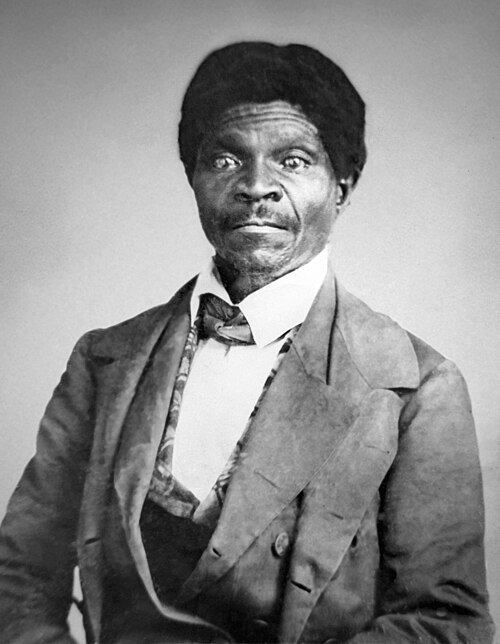
Dred Scott was an enslaved man whose owner had taken him to live in Illinois and in the Wisconsin Territory, where slavery was banned. Scott sued for his freedom. In 1857 the Supreme Court, led by Chief Justice Roger Taney, ruled against him. Taney wrote that Black Americans, free or enslaved, could not be citizens and had "no rights which the white man was bound to respect." He went further: Congress had no power to ban slavery in any territory, so the Missouri Compromise had been unconstitutional all along. The ruling thrilled the South and enraged the North, where it seemed to mean slavery could spread anywhere.
Dred Scott, about 1857. He was freed by a new owner soon after the decision and died of tuberculosis in 1858. Uncredited, circa 1857. Public domain.
Lincoln, Douglas and John Brown
In 1858 Abraham Lincoln, a little-known Illinois lawyer, challenged Stephen Douglas for his Senate seat. "A house divided against itself cannot stand," Lincoln said; the country could not "endure, permanently, half slave and half free." In seven famous debates, Lincoln argued that slavery was a moral wrong that must not spread; Douglas insisted each territory should decide for itself. Douglas kept his seat, but the debates made Lincoln nationally known.
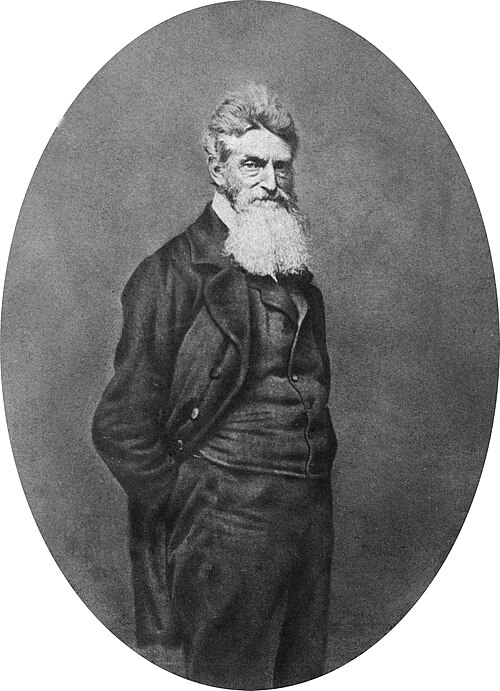
In October 1859 John Brown led 21 men, white and Black, in a raid on the federal armory at Harpers Ferry, Virginia, hoping to arm enslaved people for an uprising. The raid failed within two days; U.S. Marines under Colonel Robert E. Lee captured Brown, and he was hanged for treason. Many Northerners condemned the raid but praised Brown as a martyr.
John Brown in 1859, the year of the Harpers Ferry raid. Martin M. Lawrence, May 1859. Public domain.
To many white Southerners, that praise proved the North wanted a slave rebellion.
The election of 1860 and secession
The Democratic Party split in two, Northern and Southern, and a fourth party also ran. Lincoln won with about 40 percent of the popular vote, carrying every free state and none of the slave states; he wasn't even on the ballot in most of the South. Although the Republicans promised only to stop slavery's expansion, not to end it where it existed, Southern leaders saw a president elected without a single Southern vote as a threat they could not accept.
On December 20, 1860, South Carolina voted to secede, declaring in its official statement that Northern states had shown "an increasing hostility … to the institution of slavery." By February 1861, six more Deep South states had followed. Together they formed the Confederate States of America and chose Jefferson Davis as president. Its vice president, Alexander Stephens, said the new government's "cornerstone rests upon the great truth that the negro is not equal to the white man; that slavery … is his natural and normal condition." President Buchanan said secession was illegal but that he had no power to stop it. When Lincoln took office in March 1861, the country was already broken in two.
1850Compromise of 1850, including the Fugitive Slave Act.
1852Uncle Tom's Cabin published.
1854Kansas-Nebraska Act; the Republican Party is founded.
1856"Bleeding Kansas"; Senator Sumner beaten in the Senate.
1857Dred Scott v. Sandford.
1858Lincoln–Douglas debates.
1859John Brown's raid on Harpers Ferry.
1860Lincoln elected; South Carolina secedes in December.
1861The Confederacy is formed in February.
The presidents of this era
13Millard Fillmore
13th president · 1850–1853 · Whig
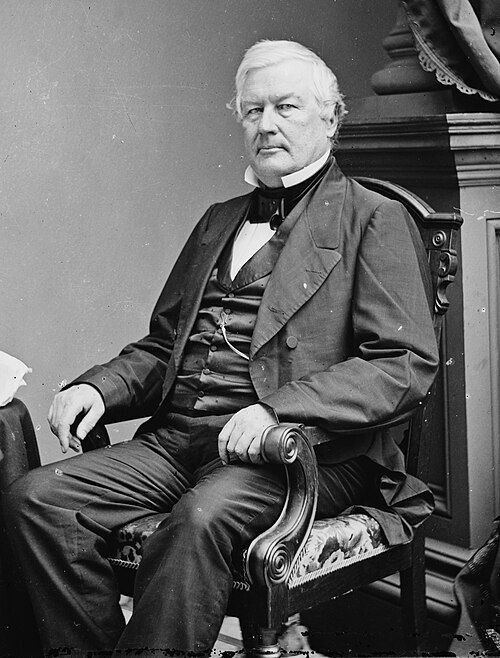
Fillmore became president when Zachary Taylor died and quickly signed the Compromise of 1850, including the Fugitive Slave Act, which made him deeply unpopular in the North. He sent Commodore Matthew Perry's fleet to open trade with Japan. He was the last Whig president; in 1856 he ran again for the anti-immigrant Know-Nothing Party.
14Franklin Pierce
14th president · 1853–1857 · Democratic
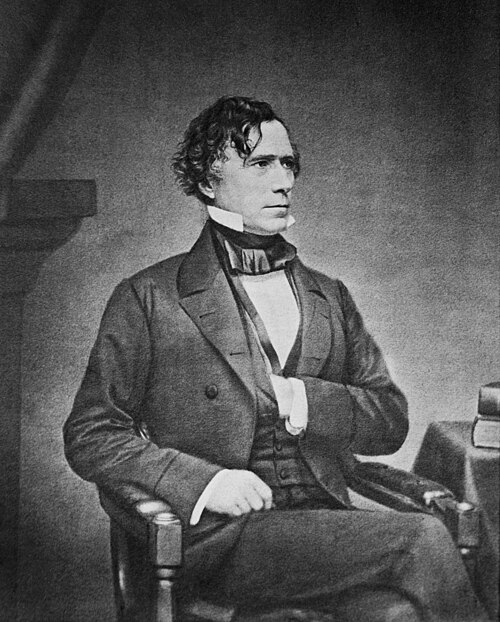
A Northern Democrat sympathetic to the South, Pierce signed the Kansas-Nebraska Act and backed the proslavery government in Kansas, helping to set off the violence there. He also completed the Gadsden Purchase (1853), buying southern Arizona and New Mexico from Mexico for a railroad route. His own party refused to nominate him for a second term.
15James Buchanan
15th president · 1857–1861 · Democratic
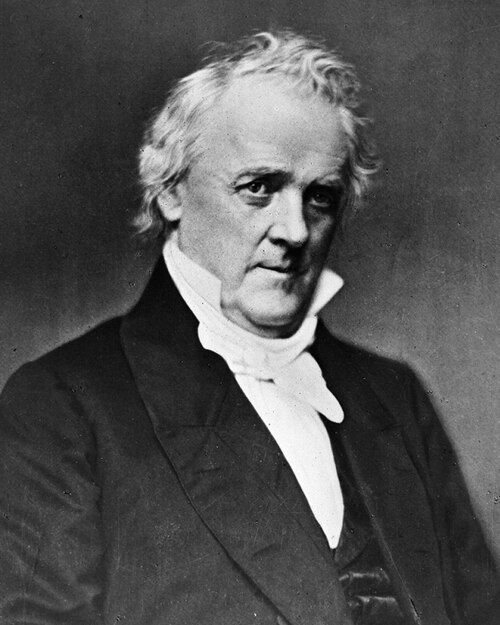
One of the most experienced politicians ever to become president, Buchanan quietly pressured the Supreme Court to rule broadly in Dred Scott and supported a proslavery constitution for Kansas. When Southern states seceded after Lincoln's election, he declared secession illegal but did nothing to stop it. Historians regularly rank him among the worst presidents.
Check your understanding
Why did the Fugitive Slave Act turn many Northerners against slavery?
How did the Kansas-Nebraska Act lead to violence?
What two things did Chief Justice Taney rule in the Dred Scott case?
Show answersHide answers
1. It forced them to take part in slavery
Before 1850, many Northerners could see slavery as a Southern problem. The new law required them to help capture people who had escaped, denied accused people a jury trial, and allowed free Black Northerners to be kidnapped into slavery. Seeing people seized in Boston or Philadelphia made slavery personal, and turned many neutral Northerners into opponents.
2. It let settlers vote on slavery, so both sides rushed in to win the vote
By replacing the Missouri Compromise line with popular sovereignty, the act turned Kansas into a contest. Proslavery Missourians crossed the border to vote illegally, two rival governments formed, and raids and killings followed on both sides. It also led directly to the founding of the Republican Party.
3. Black people couldn't be citizens, and Congress couldn't ban slavery in the territories
The first part meant Dred Scott had no right even to sue in federal court. The second declared the Missouri Compromise unconstitutional and threatened the Republican Party's whole program of stopping slavery's spread. Rather than settling the issue, as Buchanan had hoped, the ruling inflamed it.
Chapter 9 · 1861–1865
The Civil War
The Civil War was the deadliest conflict in American history. Somewhere between 620,000 and 750,000 soldiers died, roughly as many as in all other American wars combined. It began as a war to restore the Union. By its end it had also become a war to end slavery, and about four million people were free.
Fort Sumter and choosing sides
In his inaugural address in March 1861, Lincoln promised not to interfere with slavery where it existed, but said secession was illegal and that he would hold federal property. One of the last federal posts in the Deep South was Fort Sumter, in the harbor of Charleston, South Carolina. When Lincoln sent supplies, Confederate guns opened fire on April 12, 1861, and the fort surrendered the next day. Lincoln called for 75,000 volunteers to put down the rebellion. Rather than fight against other Southern states, Virginia, North Carolina, Tennessee and Arkansas joined the Confederacy, bringing it to eleven states. Four slave states (Delaware, Maryland, Kentucky and Missouri) stayed in the Union, and the western counties of Virginia broke away to become West Virginia in 1863.
Two sides, unequal strengths
The North had more than twice the South's population and about 90 percent of the nation's factories, most of its railroads and a navy. The South had skilled officers, including General Robert E. Lee, and the advantage of fighting on its own ground; it didn't need to conquer the North, only to survive until the North gave up. The Union's plan, nicknamed the Anaconda Plan, was to blockade Southern ports, take control of the Mississippi River to split the Confederacy, and capture its capital, Richmond.
Both sides expected a short war. That hope ended at the first Battle of Bull Run (Manassas) in July 1861, a Confederate victory that sent Union troops and picnicking spectators fleeing back to Washington. For the next two years Lee's army repeatedly beat larger Union forces in Virginia, while in the West, Union General Ulysses S. Grant won key victories along the Tennessee and Mississippi rivers.
Emancipation
Enslaved people forced the question of slavery from the start, by escaping to Union lines by the thousands. Union officers began treating them as "contraband of war" rather than returning them. Lincoln personally believed slavery was wrong, but he moved carefully, fearing that a war for abolition would drive the border states into the Confederacy.
On September 17, 1862, Union troops stopped Lee's invasion of Maryland at Antietam, the bloodiest single day in American history, with about 23,000 soldiers killed, wounded or missing. Five days later Lincoln announced the Emancipation Proclamation, which took effect January 1, 1863. It declared free all enslaved people in areas still in rebellion. It didn't apply to the loyal border states, and it couldn't be enforced until Union armies arrived. But it turned the Union army into an army of liberation, discouraged Britain and France from backing the Confederacy, and opened the army to Black soldiers.
Black soldiers
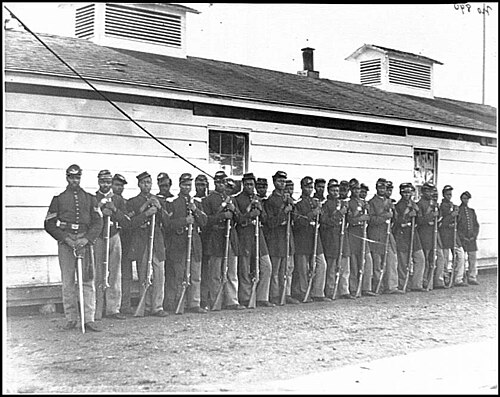
About 180,000 Black men served in the Union Army, roughly a tenth of its strength, and about 19,000 in the Navy. Most had been enslaved. They served in segregated units called the United States Colored Troops under white officers, and for most of the war they were paid less than white soldiers. In July 1863 the 54th Massachusetts, one of the first Black regiments, led a doomed assault on Fort Wagner in South Carolina; its courage changed many white Northerners' minds about Black soldiers.
Company E, 4th U.S. Colored Infantry, at Fort Lincoln near Washington, D.C., about 1865. William Morris Smith, about 1865. Public domain.
Confederates threatened to enslave or execute captured Black soldiers, and at Fort Pillow, Tennessee, in 1864 they killed many who tried to surrender.
Gettysburg and Vicksburg
In the summer of 1863, Lee invaded the North again. At Gettysburg, Pennsylvania, from July 1 to 3, the two armies fought the largest battle ever in North America. On the last day, Lee sent about 12,500 men in a massive charge, led in part by General George Pickett, across open fields toward the Union center; it was cut to pieces. Lee retreated and never invaded the North again. On July 4, the day after Gettysburg ended, Grant captured Vicksburg, Mississippi, after a long siege, giving the Union control of the Mississippi River and splitting the Confederacy in two.
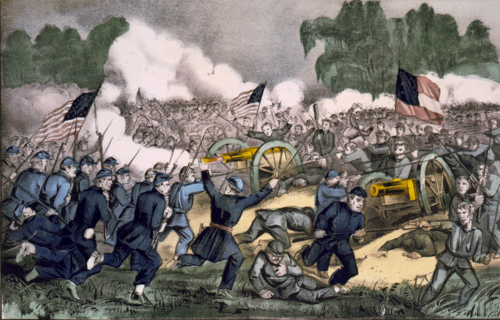
The Battle of Gettysburg as shown in a Currier & Ives print of the 1860s. Prints like this brought the war's battles into Northern homes. Currier and Ives. Public domain.
In November 1863 Lincoln spoke at the dedication of a cemetery for the Union dead at Gettysburg. His speech lasted about two minutes. It redefined the war as a test of whether a nation "conceived in Liberty, and dedicated to the proposition that all men are created equal" could survive:
"…that we here highly resolve that these dead shall not have died in vain — that this nation, under God, shall have a new birth of freedom — and that government of the people, by the people, for the people, shall not perish from the earth."Abraham Lincoln, the Gettysburg Address, November 19, 1863
The home fronts
Both sides drafted soldiers for the first time. In the North, wealthy men could pay $300 to avoid service, which led to the charge of "a rich man's war and a poor man's fight." In July 1863, riots against the draft in New York City turned into attacks on Black residents; over 100 people were killed. In the South, shortages and inflation were far worse; prices rose about 9,000 percent over the war, and hungry women led bread riots in Richmond. Hundreds of thousands of women on both sides ran farms and businesses, worked in factories and served as nurses. Clara Barton, who nursed soldiers on the battlefield, later founded the American Red Cross.
Total war and surrender
In 1864 Lincoln put Grant in charge of all Union armies. Grant pressed Lee relentlessly in Virginia despite enormous losses, while General William T. Sherman captured Atlanta and then marched 60,000 troops to the sea at Savannah, destroying railroads, crops and anything else that could support the Confederate war effort. The fall of Atlanta helped Lincoln win reelection in November 1864. In January 1865 Congress passed the 13th Amendment abolishing slavery and sent it to the states.
In April 1865 Lee abandoned Richmond. Trapped, he surrendered to Grant at Appomattox Court House, Virginia, on April 9. Grant's terms were generous: Confederate soldiers could go home, keeping their horses for spring planting. The remaining Confederate forces surrendered over the following weeks.
The assassination
Five days after Appomattox, on April 14, 1865, Lincoln was shot at Ford's Theatre in Washington by John Wilkes Booth, an actor and Confederate sympathizer. He died the next morning, the first American president to be assassinated. Millions watched as his funeral train carried his body home to Springfield, Illinois. In his second inaugural address, a month before, he had hoped to heal the nation "with malice toward none, with charity for all." Without him, the country would have to decide how to rebuild.
Apr 1861Confederates fire on Fort Sumter; the war begins.
Jul 1861First Battle of Bull Run.
Sep 1862Antietam, the bloodiest day in American history.
Jan 1863Emancipation Proclamation takes effect.
Jul 1863Union victories at Gettysburg and Vicksburg; the 54th Massachusetts at Fort Wagner.
Nov 1863Gettysburg Address.
1864Grant takes command; Sherman captures Atlanta and marches to the sea; Lincoln reelected.
Apr 1865Lee surrenders at Appomattox (April 9); Lincoln assassinated (April 14).
Dec 186513th Amendment ratified; slavery abolished.
The president of this era
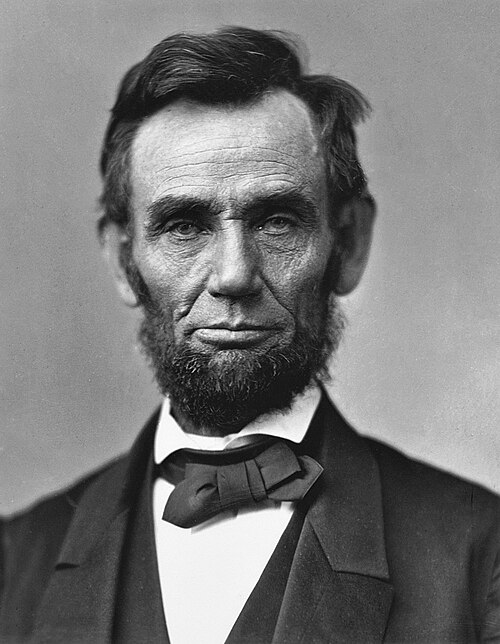
16Abraham Lincoln
16th president · 1861–1865 · Republican
Born in a Kentucky log cabin and largely self-educated, Lincoln rose to become a successful Illinois lawyer and a one-term congressman before the slavery debates made him a national figure. As president he held the Union together through four years of war, often against bitter criticism from all sides, including over his suspension of habeas corpus, which allowed people to be jailed without trial. He issued the Emancipation Proclamation, pushed the 13th Amendment through Congress, and gave two of the greatest speeches in American history, the Gettysburg Address and his second inaugural. He was assassinated weeks after winning the war. Historians consistently rank him among the greatest presidents, usually first.
Check your understanding
What did the Emancipation Proclamation do, and what didn't it do?
Why were Gettysburg and Vicksburg, in July 1863, a turning point?
How did enslaved people themselves push the war toward emancipation?
Show answersHide answers
1. It freed people in rebel-held areas, but not in the loyal border states
The proclamation used Lincoln's war powers to free enslaved people in states still fighting the Union. It didn't cover Delaware, Maryland, Kentucky or Missouri, and in practice freedom came only as Union armies advanced. Still, it made ending slavery a goal of the war, let Black men join the army, and kept Europe from recognizing the Confederacy. The 13th Amendment later ended slavery everywhere.
2. Lee's last invasion of the North failed, and the Union took the Mississippi
After Gettysburg, Lee's army never again went on the offensive in the North. Vicksburg's surrender the next day gave the Union the whole Mississippi River and cut off Texas, Arkansas and Louisiana from the rest of the Confederacy. The war went on for almost two more years, but the Confederacy's chances of winning had fallen sharply.
3. They escaped to Union lines and then fought in the Union army
From the first months of the war, enslaved people fled to Union camps by the thousands, forcing officers and politicians to decide what to do with them. Treating them as "contraband" weakened the South's labor force. After emancipation, about 180,000 Black men, most formerly enslaved, served in the Union Army, and their service strengthened the case for ending slavery completely.
Chapter 10 · 1865–1877
Reconstruction
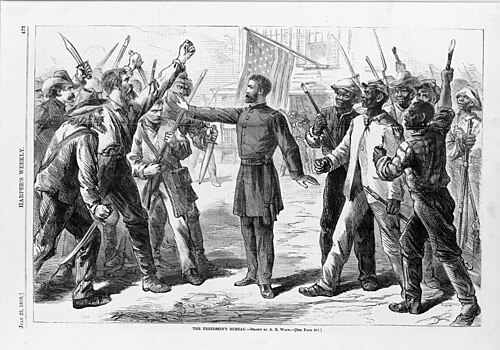
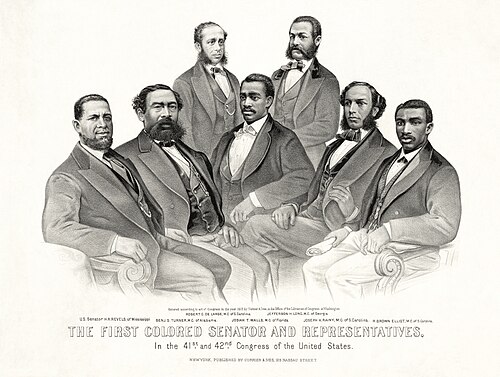
The Union had won the war, and four million people were free. But the country now faced questions nobody had answered before. On what terms would the Confederate states rejoin? What did freedom mean for people who had been enslaved: citizenship, the vote, land of their own? For twelve years, called Reconstruction, Americans fought over those questions. Formerly enslaved people made remarkable gains, and the Constitution was rewritten to promise equal rights. Then violence and fading Northern commitment undid much of that progress for nearly a century.
Presidential Reconstruction
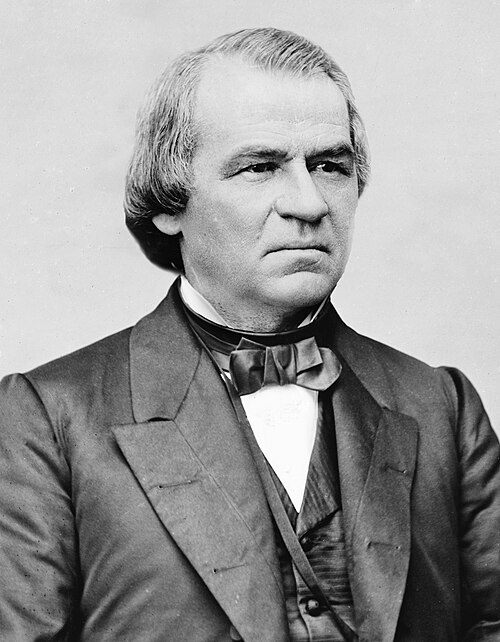
Andrew Johnson, a Tennessee Democrat who had stayed loyal to the Union, became president when Lincoln was killed. He hated the Southern planter elite, but he also believed in white supremacy and wanted the Southern states back quickly. In 1865 he pardoned most former Confederates and let the states form new governments, requiring only that they abolish slavery and accept the 13th Amendment, ratified that December.
The new Southern governments, often led by former Confederate officials, quickly passed Black Codes. These laws limited where Black people could work and live, forced them to sign yearlong labor contracts, and let sheriffs arrest unemployed Black men for "vagrancy" and hire them out to planters. To many Northerners it looked as though the South was trying to bring back slavery under another name.
Congress takes over
The Republicans who controlled Congress, especially the "Radical Republicans" led by Thaddeus Stevens and Charles Sumner, refused to seat the new Southern representatives. In 1866 Congress passed a Civil Rights Act over Johnson's veto, and then wrote the 14th Amendment (ratified 1868). It made everyone born in the United States a citizen and barred states from denying any person "due process of law" or "the equal protection of the laws." It is still the basis of most civil rights cases today.
The Reconstruction Acts of 1867 divided ten Southern states into five military districts. To rejoin the Union, each had to write a new constitution allowing Black men to vote and ratify the 14th Amendment. When Johnson tried to block the laws, the House impeached him in 1868, the first presidential impeachment. The Senate fell one vote short of the two-thirds needed to remove him. The 15th Amendment (1870) then barred denying the vote because of "race, color, or previous condition of servitude." It didn't include women, which split the women's rights movement.
Freedom in practice
Freed people moved quickly to build lives of their own. They searched for family members sold away years before, legalized marriages, founded churches and, above all, sought education. The Freedmen's Bureau, created in 1865, provided food, medical care and help with labor contracts, and with Northern charities it helped set up some 1,000 schools. Colleges such as Howard University and Fisk University were founded in these years.
"The Freedmen's Bureau," an 1868 Harper's Weekly engraving by Alfred Waud, shows a Bureau agent standing between angry white Southerners and freed Black Southerners. Alfred R. Waud, 1868. Public domain.
Most freed people wanted land. A wartime order by General Sherman had set aside land on the coast of South Carolina and Georgia for families, the origin of the phrase "forty acres and a mule," but Johnson ordered it returned to its former owners. Without land, most freed families ended up sharecropping: farming a piece of a white landowner's property in exchange for a share of the crop. High interest on supplies bought on credit kept many sharecroppers in debt year after year.
Black men voted in huge numbers, and for the first time Black Americans held public office. About 2,000 served, from local sheriffs to state legislators. Sixteen served in Congress, including Hiram Revels of Mississippi, the first Black senator, elected in 1870. The new state governments, made up of Black and white Republicans, created the South's first public school systems and rebuilt roads and railroads.
"The First Colored Senator and Representatives," an 1872 Currier & Ives print. Hiram Revels, seated at left, was the first Black U.S. senator. Currier and Ives, 1872. Public domain.
Terror and retreat
Many white Southerners never accepted these changes. The Ku Klux Klan, founded by Confederate veterans in Tennessee in 1865, and similar groups used beatings, arson and murder to stop Black people from voting and to drive Republicans from office. Congress passed the Enforcement Acts of 1870–71, and President Grant used them to arrest hundreds of Klansmen, which broke the first Klan. But the violence continued under other names. In the Colfax Massacre in Louisiana in 1873, a white mob killed dozens, and possibly more than 100, Black men.
Northern support faded. A financial crash, the Panic of 1873, turned voters' attention to the economy, scandals in Grant's administration embarrassed Republicans, and many white Northerners simply tired of the issue. The Supreme Court narrowed the reach of the 14th Amendment in the Slaughterhouse Cases (1873) and United States v. Cruikshank (1876). One by one, white Democrats who called themselves "Redeemers" took back Southern state governments, often through fraud and violence.
The Compromise of 1877
The presidential election of 1876 between Republican Rutherford B. Hayes and Democrat Samuel Tilden ended in a dispute over the electoral votes of three Southern states. A special commission gave all of them to Hayes. In an informal deal, Democrats accepted Hayes as president, and Hayes withdrew the last federal troops protecting Republican governments in the South. Reconstruction was over.
Within a generation, Southern states used poll taxes, literacy tests and violence to take away most Black men's votes and passed "Jim Crow" laws enforcing segregation. The 14th and 15th Amendments stayed in the Constitution, but they wouldn't be fully enforced until the civil rights movement of the 1950s and '60s, which historians sometimes call the "Second Reconstruction."
1865Freedmen's Bureau created; Black Codes passed; 13th Amendment ratified; Klan founded.
1866Civil Rights Act passed over Johnson's veto.
1867Reconstruction Acts; the U.S. buys Alaska from Russia.
1868Johnson impeached and acquitted; 14th Amendment ratified; Grant elected.
1869Transcontinental railroad completed.
187015th Amendment; Hiram Revels becomes the first Black senator.
1873Panic of 1873; Colfax Massacre.
1877Compromise of 1877; federal troops leave the South.
The presidents of this era
17Andrew Johnson
17th president · 1865–1869 · National Union (a Democrat elected on Lincoln's Union ticket)
The only Southern senator to stay loyal to the Union in 1861, Johnson was chosen as Lincoln's running mate in 1864 to show national unity. As president he pardoned former Confederates, vetoed civil rights laws and opposed the 14th Amendment, putting him in open war with Congress. He became the first president impeached, and escaped removal by one vote. His secretary of state, William Seward, bought Alaska from Russia in 1867.
18Ulysses S. Grant
18th president · 1869–1877 · Republican
The general who won the Civil War, Grant supported the 15th Amendment and used federal troops and the Enforcement Acts to crush the Ku Klux Klan. The transcontinental railroad was completed in his first year. His administration was damaged by corruption among his appointees, including the Whiskey Ring tax fraud, though Grant himself wasn't found to be corrupt. Dying of cancer and nearly bankrupt, he wrote a celebrated memoir to support his family. Historians have rated him more highly in recent decades.
Check your understanding
What did each of the three Reconstruction Amendments (13th, 14th and 15th) do?
Why did most freed families end up sharecropping?
What was the Compromise of 1877, and why does it mark the end of Reconstruction?
Show answersHide answers
1. Freedom, citizenship and equal protection, and the vote
The 13th (1865) abolished slavery. The 14th (1868) made everyone born in the U.S. a citizen and guaranteed due process and equal protection of the laws. The 15th (1870) barred denying the vote because of race or former enslavement. Together they rewrote the Constitution, though Southern states found ways around them for decades.
2. They didn't get land of their own
Freed people hoped to farm their own land, but the government returned confiscated land to former owners, and few had money to buy any. Sharecropping let them work land in exchange for part of the crop, with more independence than gang labor under slavery. But buying seed, tools and food on credit at high interest trapped many families in debt.
3. A deal that made Hayes president in exchange for pulling troops out of the South
The 1876 election was disputed, and Democrats agreed to accept Republican Rutherford B. Hayes as president. In return, Hayes withdrew the federal troops that protected the last Republican state governments in the South. Without federal protection, white Democrats took full control and began stripping away Black Southerners' rights.
Part III · Industry and empire
Chapter 11 · 1877–1900
The Gilded Age
In the quarter century after Reconstruction, the United States became the world's largest industrial economy. Railroads stitched the continent together, factories and cities grew at astonishing speed, and millions of immigrants arrived to work in them. Mark Twain called it the "Gilded Age": a thin coat of gold over serious problems underneath, including corruption, dangerous working conditions, the conquest of the last independent Native nations, and the spread of legal segregation in the South.
Railroads and the industrial boom
On May 10, 1869, the Union Pacific and Central Pacific railroads met at Promontory Summit, Utah, completing the first transcontinental line. Much of the Central Pacific was built by Chinese immigrant workers, and much of the Union Pacific by Irish immigrants and Civil War veterans. By 1900 the country had nearly 200,000 miles of track, up from about 35,000 at the end of the Civil War. Railroads created national markets: beef from Chicago, steel from Pittsburgh and clothing from New York could be sold anywhere.
The "last spike" ceremony at Promontory Summit, Utah, May 10, 1869, joining the country by rail. Andrew J. Russell / Adam Cuerden. Public domain.
A handful of industrialists built enormous companies. Andrew Carnegie dominated steel, John D. Rockefeller's Standard Oil controlled about 90 percent of American oil refining, and J. P. Morgan financed railroads and banks. Admirers called them "captains of industry"; critics called them "robber barons." Many, like Carnegie, gave away large fortunes to libraries, universities and concert halls. New inventions changed daily life: Alexander Graham Bell's telephone (1876), Thomas Edison's practical light bulb (1879) and the first skyscrapers in Chicago and New York.
Immigration and the growing cities
Between 1880 and 1920, more than 20 million immigrants came to the United States. Earlier arrivals had mostly come from Britain, Ireland and Germany; now many came from Italy, Poland, Russia, Greece and Austria-Hungary, including large numbers of Catholic and Jewish families. From 1892, most passed through the federal immigration station at Ellis Island in New York Harbor, where inspectors checked their health and papers.
New arrivals at Ellis Island around 1902. In its busiest years the station processed several thousand people a day. Unknown authorUnknown author, 1902. Public domain.
Immigrants crowded into city tenements, worked in factories, mines and sweatshops, and built neighborhoods with their own churches, synagogues, newspapers and mutual-aid societies. Political "machines" such as New York's Tammany Hall traded jobs and favors for votes, mixing real help for newcomers with large-scale corruption. Reformers like Jane Addams, who opened Hull House in Chicago in 1889, offered classes, child care and health services to immigrant families.
Not every group was welcome. The Chinese Exclusion Act of 1882 banned Chinese laborers from immigrating, the first U.S. law to bar a group by nationality. It stayed in force until 1943.
The end of the Plains wars
As railroads, ranchers and homesteaders moved west, the U.S. Army fought a series of wars against the Lakota, Cheyenne, Comanche, Apache, Nez Perce and other nations. Commercial hunters killed tens of millions of buffalo, destroying the food supply of the Plains peoples. Native victories such as the Battle of the Little Bighorn (1876), where Lakota and Cheyenne warriors defeated George Custer's 7th Cavalry, did not stop the pressure. By the 1880s most Native nations had been forced onto reservations.
The Dawes Act of 1887 broke up reservation land into individual plots, and "surplus" land was sold to settlers; Native landholdings fell by about two-thirds over the next fifty years. Boarding schools took children from their families to suppress their languages and cultures. In December 1890, the army killed more than 250 Lakota men, women and children at Wounded Knee Creek in South Dakota, an event usually seen as the end of the Indian Wars.
Workers organize
Factory work often meant 10- to 12-hour days, six days a week, with child labor and frequent deadly accidents. Workers formed unions to bargain for better pay and conditions. The Knights of Labor grew to hundreds of thousands of members in the 1880s, and in 1886 Samuel Gompers founded the American Federation of Labor (AFL) for skilled workers. Strikes were often met with force: the Great Railroad Strike of 1877, the Haymarket bombing in Chicago (1886), the Homestead steel strike (1892) and the Pullman railroad strike (1894), which President Cleveland ended by sending federal troops.
Farmers, squeezed by falling crop prices and high railroad rates, formed the Populist (People's) Party in 1892. They called for regulating railroads, an income tax and the direct election of senators. Many of those ideas became law in the next generation.
Jim Crow and Plessy v. Ferguson
After Reconstruction ended, Southern states passed "Jim Crow" laws that segregated Black Americans in schools, trains, restaurants and nearly every public place, and used poll taxes, literacy tests and violence to keep them from voting. Thousands of Black Americans were murdered by lynch mobs between the 1880s and the 1960s; journalist Ida B. Wells documented the killings and campaigned against them. In Plessy v. Ferguson (1896), the Supreme Court ruled that segregation was constitutional as long as facilities were "separate but equal." In practice they were rarely equal, and the ruling stood until 1954.
An overseas empire
In 1898, after the battleship USS Maine exploded in Havana harbor, the United States went to war with Spain over Cuba. The Spanish-American War lasted less than four months. Spain gave up Cuba, and the United States took Puerto Rico, Guam and the Philippines; it annexed Hawaii the same year, after American businessmen had overthrown Queen Liliʻuokalani in 1893. Filipinos who had fought Spain for independence then fought the United States in the Philippine-American War (1899–1902), in which more than 200,000 Filipinos died, most of them civilians. Americans argued fiercely over whether a nation founded in a revolt against empire should hold colonies.
1876Battle of the Little Bighorn; Bell patents the telephone.
1877Reconstruction ends; Great Railroad Strike.
1882Chinese Exclusion Act.
1886Haymarket affair; the AFL is founded.
1890Wounded Knee massacre.
1892Ellis Island opens.
1896Plessy v. Ferguson upholds segregation.
1898Spanish-American War; Hawaii annexed.
The presidents of the Gilded Age
19Rutherford B. Hayes
19th president · 1877–1881 · Republican
Hayes won the disputed election of 1876 after a deal in which Republicans agreed to withdraw the last federal troops from the South, ending Reconstruction. He used federal troops to break the Great Railroad Strike of 1877 and began modest reforms of the government's patronage system.
20James A. Garfield
20th president · 1881 · Republican
A former Union general and Ohio congressman, Garfield was shot by a disappointed office seeker just four months into his term and died eleven weeks later, partly from infections caused by his doctors. His assassination built public support for civil service reform.
21Chester A. Arthur
21st president · 1881–1885 · Republican
Arthur had been known as a machine politician, but as president he surprised critics by signing the Pendleton Act of 1883, which required many federal jobs to be filled by merit exams rather than political favors. He also signed the Chinese Exclusion Act.
22 & 24Grover Cleveland
22nd and 24th president · 1885–1889 and 1893–1897 · Democratic
Cleveland is the only president to serve two non-consecutive terms, which is why he's counted as both the 22nd and 24th. A blunt reformer, he vetoed hundreds of bills he considered wasteful. His second term was dominated by the severe Panic of 1893 and by his use of federal troops to end the Pullman Strike.
23Benjamin Harrison
23rd president · 1889–1893 · Republican
The grandson of President William Henry Harrison, he won the Electoral College while losing the popular vote to Cleveland. He signed the Sherman Antitrust Act (1890), the first federal law against monopolies, and six states joined the Union during his term, more than under any other president.
25William McKinley
25th president · 1897–1901 · Republican
McKinley led the country through the Spanish-American War, which made the United States a power in the Pacific and the Caribbean, and he supported high tariffs to protect American industry. Six months into his second term, he was assassinated by an anarchist in Buffalo, New York.
Check your understanding
Why did Mark Twain call this period the "Gilded Age"?
What did the Supreme Court decide in Plessy v. Ferguson?
Which territories did the United States gain as a result of the Spanish-American War?
Show answersHide answers
1. It looked golden on the surface but hid deep problems
Something "gilded" has only a thin layer of gold on top. The era's railroads, fortunes and inventions were real, but underneath were political corruption, dangerous and low-paid work, crowded tenements and widespread poverty.
2. Segregation was legal if facilities were "separate but equal"
The 1896 ruling upheld a Louisiana law segregating train cars and gave constitutional cover to Jim Crow laws across the South. Facilities for Black Americans were almost never truly equal. The Court reversed itself in Brown v. Board of Education in 1954.
3. Puerto Rico, Guam and the Philippines
Spain gave these up in the 1898 peace treaty, and Cuba became independent under heavy American influence. Hawaii was annexed the same year, though not as part of the war's peace treaty. The Philippines became independent in 1946, while Puerto Rico and Guam are still U.S. territories.
Chapter 12 · 1901–1920
The Progressive Era and World War I
By 1900 many Americans believed industrial growth had gone too far without rules. Progressives, a broad movement of reformers from both major parties, set out to use government to fix the problems of the Gilded Age: monopolies, unsafe food and factories, corrupt city governments and child labor. Their era ended with the United States fighting in its first major European war.
The muckrakers
Investigative journalists, nicknamed "muckrakers" by Theodore Roosevelt, exposed abuses to a mass readership. Ida Tarbell's history of Standard Oil revealed Rockefeller's ruthless tactics. Jacob Riis photographed New York's tenements in How the Other Half Lives (1890). Upton Sinclair's novel The Jungle (1906) described filthy Chicago meatpacking plants; within months Congress passed the Meat Inspection Act and the Pure Food and Drug Act, the beginning of today's FDA. Photographer Lewis Hine documented children working in mills and mines, building support for child labor laws.
The Triangle Shirtwaist Factory fire in New York in 1911 killed 146 garment workers, most of them young immigrant women, who were trapped behind locked doors. The disaster led New York and other states to pass new fire-safety and labor laws.
Taming big business
Roosevelt promised Americans a "Square Deal." His administration used the Sherman Antitrust Act to break up the Northern Securities railroad trust, and in 1911 the Supreme Court ordered Standard Oil split into 34 companies. Progressives also passed laws regulating railroad rates and, under Woodrow Wilson, created the Federal Reserve (1913) to steady the banking system and the Federal Trade Commission (1914) to police unfair business practices.
Conservation and the national parks
Roosevelt, an avid outdoorsman, protected about 230 million acres of public land as national forests, wildlife refuges, national monuments and parks. Naturalist John Muir and forester Gifford Pinchot debated whether land should be preserved untouched or managed for careful use, a debate that continues today. In 1916 Congress created the National Park Service to manage the growing system, which already included Yellowstone, the first national park (1872), and Yosemite.
Four amendments in seven years
Progressive reformers changed the Constitution four times between 1913 and 1920:
16th Amendment (1913): allowed a federal income tax.
17th Amendment (1913): made U.S. senators directly elected by voters instead of chosen by state legislatures.
18th Amendment (1919): banned the manufacture and sale of alcohol, beginning Prohibition (repealed in 1933).
19th Amendment (1920): guaranteed women the right to vote.
The fight for women's suffrage had begun at Seneca Falls in 1848. Leaders like Susan B. Anthony and Elizabeth Cady Stanton did not live to see it won. A new generation, including Carrie Chapman Catt and the more confrontational Alice Paul, organized parades, lobbying campaigns and protests outside the White House, where many women were jailed. Several Western states, starting with Wyoming, had already given women the vote before the amendment passed.
The official program for the Woman Suffrage Procession in Washington, D.C., on March 3, 1913, the day before Wilson's inauguration. About 5,000 women marched, and hostile crowds attacked many of them. Benjamin Moran Dale (1889-1951), for the National American Women's Suffrage Association, 1913. Public domain.
The Great Migration begins
Around 1915, Black Southerners began leaving the South in huge numbers, escaping Jim Crow laws, lynching and sharecropping for factory jobs in Chicago, Detroit, New York, Philadelphia and other cities. Over the next fifty years about six million people made the move, changing the culture and politics of the whole country. Black leaders debated strategy: Booker T. Washington emphasized education and economic self-help, while W. E. B. Du Bois demanded full civil and political rights now and helped found the NAACP in 1909.
World War I
When war broke out in Europe in 1914, President Wilson declared American neutrality. Pressure built after a German submarine sank the British liner Lusitania in 1915, killing 128 Americans. In early 1917 Germany resumed unrestricted submarine warfare, and the British intercepted the Zimmermann Telegram, in which Germany proposed an alliance with Mexico against the United States. Congress declared war in April 1917; Wilson said the world "must be made safe for democracy."
About two million American soldiers, called "doughboys," reached France, and their arrival helped tip the balance against Germany in 1918. Around 116,000 Americans died, roughly half of them from disease. At home, the government drafted soldiers, sold Liberty Bonds and passed laws restricting speech against the war; hundreds of people, including socialist leader Eugene V. Debs, were imprisoned for opposing it. The war ended with an armistice on November 11, 1918.
The influenza pandemic of 1918–1919, spread in part by troop movements, killed about 675,000 Americans and an estimated 50 million people worldwide, far more than the war itself.
At the peace conference, Wilson proposed his "Fourteen Points" and a League of Nations to settle future disputes. The Senate, worried the League would drag the United States into foreign wars, refused to ratify the treaty, and the United States never joined the League.
1901McKinley assassinated; Theodore Roosevelt becomes president.
1906The Jungle; Pure Food and Drug Act.
1909The NAACP is founded.
1911Triangle Shirtwaist fire; Standard Oil broken up.
191316th and 17th Amendments; Federal Reserve created.
1916National Park Service created.
1917The U.S. enters World War I.
1918Armistice ends the fighting; flu pandemic.
192019th Amendment: women win the vote.
The presidents of the Progressive Era
26Theodore Roosevelt
26th president · 1901–1909 · Republican
At 42, Roosevelt became the youngest president after McKinley's assassination. He broke up trusts, protected millions of acres of land, pushed food and drug safety laws and began the Panama Canal. Abroad he followed the motto "speak softly and carry a big stick," and he won the Nobel Peace Prize for helping end the Russo-Japanese War.
27William Howard Taft
27th president · 1909–1913 · Republican
Roosevelt's chosen successor brought even more antitrust cases than Roosevelt had, but split with him over tariffs and conservation. Their feud divided the Republican Party in 1912. Taft later became Chief Justice of the Supreme Court, the only person to hold both offices.
28Woodrow Wilson
28th president · 1913–1921 · Democratic
A former Princeton president, Wilson created the Federal Reserve and the Federal Trade Commission, led the country through World War I and championed the League of Nations, for which he won the Nobel Peace Prize. He also resegregated much of the federal workforce. A severe stroke in 1919 left him largely incapacitated for the rest of his term.
Check your understanding
What did Upton Sinclair's The Jungle lead Congress to do?
Which amendment gave women the right to vote, and in what year?
Why did the United States never join the League of Nations?
Show answersHide answers
1. Pass the first federal food-safety laws
Readers were horrified by Sinclair's descriptions of meatpacking plants. In 1906 Congress passed the Meat Inspection Act and the Pure Food and Drug Act, which required inspections and honest labels and grew into today's Food and Drug Administration.
2. The 19th Amendment, 1920
It was the result of more than seventy years of organizing that began at Seneca Falls in 1848. Some states had already let women vote, but the amendment made it a nationwide constitutional right.
3. The Senate refused to ratify the peace treaty
Wilson designed the League, but many senators feared its promise of collective security would commit the United States to future wars without Congress's approval. Wilson refused to accept changes, and the treaty failed.
Chapter 13 · 1920–1939
The Roaring Twenties and the Great Depression
The 1920s were a decade of prosperity, new technology and cultural change, followed by the worst economic collapse in American history. The Great Depression transformed what Americans expected from their government, and the New Deal built programs, like Social Security, that still exist today.
A new consumer society
After a brief postwar slump, the economy boomed. Henry Ford's assembly line had cut the price of a Model T so far that by the late 1920s there was roughly one car for every five Americans. Radio arrived in millions of homes, bringing national news, music and baseball broadcasts. Movies became a mass entertainment, and the first "talkie," The Jazz Singer, appeared in 1927. Buying on credit, through installment plans, let families purchase refrigerators, washing machines and cars they couldn't pay for all at once.
Not everyone shared the boom. Farmers struggled with falling prices all decade, and the wealthiest families captured a growing share of national income.
The Jazz Age and the Harlem Renaissance
Jazz, created by Black musicians in New Orleans and spread north by the Great Migration, became the sound of the decade through performers like Louis Armstrong, Duke Ellington and Bessie Smith. In New York's Harlem neighborhood, a flowering of Black art, literature and thought known as the Harlem Renaissance produced writers such as Langston Hughes, Zora Neale Hurston and Claude McKay. Young women called "flappers" cut their hair short, wore shorter skirts and openly challenged older rules of behavior.
Prohibition
The 18th Amendment banned alcohol starting in 1920. Drinking fell at first, but the ban was widely ignored: illegal bars called speakeasies flourished, and smuggling made gangsters like Al Capone rich and violent. Prohibition was repealed by the 21st Amendment in 1933, the only time a constitutional amendment has been undone.
Tensions and backlash
The decade also saw fierce resistance to change. A revived Ku Klux Klan claimed millions of members in the mid-1920s, targeting Black Americans, Catholics, Jews and immigrants. Congress passed the Immigration Act of 1924, which set strict quotas favoring northern and western Europeans and nearly ended immigration from Asia. The 1925 Scopes "Monkey Trial" in Tennessee, over teaching evolution in public schools, became a national spectacle in the clash between religious traditionalists and modernists. In 1924 Congress also granted citizenship to all Native Americans born in the United States.
The crash
Stock prices soared in the late 1920s, driven partly by people buying shares with borrowed money. In October 1929 the market collapsed; on "Black Tuesday," October 29, panicked investors sold more than 16 million shares. The crash didn't cause the Great Depression alone, but it exposed deep weaknesses: too much debt, weak banks, overproduction and falling farm income. Thousands of banks failed, wiping out families' savings because deposits weren't insured.
By 1932, about one American worker in four was unemployed. Families lost homes and farms; shantytowns of the homeless, nicknamed "Hoovervilles," appeared on the edges of cities. In 1932 thousands of World War I veterans, the "Bonus Army," marched on Washington asking for early payment of promised bonuses and were driven out by troops.
The Dust Bowl
On the southern Great Plains, years of plowing up native grasses combined with severe drought in the 1930s. Wind lifted the dry topsoil into enormous "black blizzards" that buried farms and darkened skies as far east as the Atlantic coast. Hundreds of thousands of people from Oklahoma, Texas, Kansas and nearby states left, many heading to California, a migration made famous in John Steinbeck's novel The Grapes of Wrath.
A dust storm in South Dakota in 1936. Sloan (?), Taken on 13 May 1936. Public domain."Migrant Mother," photographed by Dorothea Lange in California in 1936 for a federal agency. Dorothea Lange, 6 March 1936. Public domain.
The New Deal
Franklin D. Roosevelt won the 1932 election by a landslide, promising "a new deal for the American people." In his inaugural address he told the country that "the only thing we have to fear is fear itself." In his first hundred days, Congress passed a flood of laws, and more followed over the next several years:
Banking: a "bank holiday" closed and inspected banks, and the Federal Deposit Insurance Corporation (FDIC) began insuring deposits, which it still does.
Jobs: the Civilian Conservation Corps put young men to work planting trees and building parks; the Works Progress Administration (WPA) employed millions building roads, bridges, schools and airports, and even paid artists and writers.
Social Security (1935): created pensions for retired workers and unemployment insurance.
Labor: the Wagner Act (1935) protected workers' right to form unions, and the Fair Labor Standards Act (1938) set the first federal minimum wage and limited child labor.
Regional development: the Tennessee Valley Authority built dams that brought electricity and flood control to one of the poorest parts of the country.
Critics on the right said the New Deal made the federal government too powerful and burdened business; critics on the left said it didn't go far enough. Many programs excluded farmworkers and domestic workers, jobs largely held by Black and Mexican American workers. During the Depression, local and federal authorities also pushed hundreds of thousands of people of Mexican descent, many of them U.S. citizens, to leave for Mexico. The New Deal eased the worst suffering, but full recovery came only with the massive spending of World War II.
Harding won in a landslide by promising a "return to normalcy" after the war. His administration was damaged by corruption among his appointees, most famously the Teapot Dome scandal, in which his Interior Secretary took bribes for leasing federal oil reserves. He died suddenly of a heart attack in 1923.
30Calvin Coolidge
30th president · 1923–1929 · Republican
"Silent Cal" restored trust after Harding's scandals and presided over the boom years, favoring low taxes, limited regulation and a balanced budget. He signed the 1924 immigration quotas and chose not to run again in 1928.
31Herbert Hoover
31st president · 1929–1933 · Republican
Hoover was a celebrated engineer and humanitarian who had organized food relief in Europe during World War I. The market crashed seven months into his term. He did more than earlier presidents to fight a downturn, including public works and loans to banks, but he resisted direct federal aid to individuals, and the Depression deepened. He lost the 1932 election in a landslide.
32Franklin D. Roosevelt
32nd president · 1933–1945 · Democratic
FDR is the only president elected four times. He led the country through the Great Depression with the New Deal and through most of World War II, speaking directly to Americans in radio "fireside chats." Paralyzed from the waist down by an illness in 1921, he largely hid his disability from the public. He died in office in April 1945, weeks before Germany surrendered. After him, the 22nd Amendment (1951) limited presidents to two terms.
Check your understanding
What was the Harlem Renaissance?
Name two causes of the Great Depression besides the stock market crash.
Which New Deal programs still exist today?
Show answersHide answers
1. A flowering of Black art, music and writing in 1920s Harlem
Centered in the New York neighborhood of Harlem, it included writers like Langston Hughes and Zora Neale Hurston and musicians like Duke Ellington. It celebrated Black culture and identity and shaped American literature and music for generations.
2. For example: bank failures and heavy debt
Thousands of banks failed and took uninsured savings with them. Other causes included easy credit and debt, overproduction of goods, low farm income through the 1920s and uneven wealth, which meant many families couldn't keep buying. Any two of these are good answers.
3. Social Security, the FDIC and the minimum wage, among others
Social Security still pays retirement benefits, the FDIC still insures bank deposits, the federal minimum wage still exists, and the Tennessee Valley Authority still produces electricity. That lasting reach is why the New Deal is seen as a turning point in the federal government's role.
Chapter 14 · 1939–1945
World War II
World War II was the deadliest conflict in human history, killing an estimated 70 to 85 million people. For the United States it lasted less than four years, but it ended the Great Depression, changed American society at home and left the country the most powerful nation on earth. Franklin Roosevelt led the country through nearly all of it (see his card in Chapter 13), and Harry Truman finished it (Chapter 15).
From neutrality to Pearl Harbor
In the 1930s, aggressive dictatorships expanded: Japan invaded China, Fascist Italy conquered Ethiopia, and Nazi Germany under Adolf Hitler annexed Austria and Czechoslovakia. When Germany invaded Poland in September 1939, Britain and France declared war. By mid-1940 Germany had conquered France, leaving Britain fighting almost alone.
Most Americans wanted to stay out of the war, and Congress had passed Neutrality Acts to keep it that way. Roosevelt gradually moved the country toward helping Britain. The Lend-Lease Act of 1941 let the United States supply weapons and equipment to Britain, and later to the Soviet Union and China, calling America the "arsenal of democracy."
On the morning of December 7, 1941, Japanese aircraft attacked the U.S. Pacific Fleet at Pearl Harbor, Hawaii, sinking or damaging 19 ships and killing about 2,400 Americans. Roosevelt called it "a date which will live in infamy." Congress declared war on Japan the next day, and Germany and Italy declared war on the United States days later.
The USS Arizona burning at Pearl Harbor on December 7, 1941. 1,177 crew members died aboard her; the wreck is now a memorial. Photographer: UnknownUnknown
Retouched by: Mmxx, 1941-12-07. Public domain.
The home front
The whole economy turned to war production. Car factories built tanks and bombers, unemployment nearly disappeared, and the country produced about 300,000 military aircraft during the war. Americans bought war bonds, collected scrap metal and lived with rationing of gasoline, sugar, meat and tires. More than 16 million Americans served in the armed forces.
About six million women took jobs in factories and shipyards, symbolized by "Rosie the Riveter," and some 350,000 women served in the military. Over a million Black Americans served, in segregated units, while campaigning for a "Double V": victory over fascism abroad and over racism at home. The Bracero Program, begun in 1942, brought Mexican workers to fill farm and railroad jobs, and an estimated 300,000 to 500,000 Mexican Americans served in the military.
The "We Can Do It!" poster, made for the Westinghouse company in 1943, later became the best-known image of women's war work. J. Howard Miller (1898–1985), artist employed by Westinghouse, poster used by the War Production Co-ordinating Committee. Public domain.
Japanese American incarceration
In February 1942, Roosevelt signed Executive Order 9066. It led to about 120,000 people of Japanese ancestry on the West Coast, two-thirds of them U.S. citizens, being forced from their homes and held in remote camps such as Manzanar in California, most for the rest of the war. Many lost their farms, businesses and property. No Japanese American was ever convicted of spying or sabotage. Meanwhile the Army's 442nd Regimental Combat Team, made up mostly of Japanese Americans, became one of the most decorated units in U.S. history. In 1988 Congress formally apologized and paid $20,000 to each surviving detainee.
The war in Europe
American forces first fought German and Italian troops in North Africa in 1942, then invaded Sicily and Italy in 1943. Meanwhile the Soviet Union, at enormous human cost, turned back the German army at Stalingrad. American and British bombers struck German cities and factories. The Tuskegee Airmen, the first Black military pilots in the U.S. armed forces, flew combat missions over Europe, many of them escorting bombers.
On June 6, 1944, D-Day, more than 150,000 Allied troops landed on the beaches of Normandy, France, under the command of General Dwight D. Eisenhower: the largest seaborne invasion in history. Over the next year Allied armies pushed east while the Soviets pushed west. Hitler killed himself in Berlin, and Germany surrendered on May 8, 1945, V-E Day.
American troops wading ashore at Omaha Beach on D-Day, June 6, 1944. Photographed by Robert F. Sargent of the U.S. Coast Guard. Chief Photographer's Mate (CPHoM) Robert F. Sargent, Taken on 6 June 1944. Public domain.
The Holocaust
As Allied soldiers advanced, they liberated Nazi concentration and death camps and saw the full scale of the Holocaust: the systematic murder of about six million Jews, along with millions of Roma, disabled people, Poles, Soviet prisoners and others. Eisenhower visited a camp and ordered that it be documented so no one could later deny what had happened. Before the war the United States had accepted relatively few Jewish refugees; in 1939 the ship St. Louis, carrying more than 900 Jewish refugees, was turned away from U.S. ports, and many of its passengers later died in the Holocaust.
The war in the Pacific
Japan won a string of early victories, capturing the Philippines in 1942. The U.S. Navy's victory at the Battle of Midway in June 1942 turned the tide. American forces then "island-hopped" across the Pacific in brutal battles at Guadalcanal, Saipan, Iwo Jima and Okinawa. Navajo Code Talkers, Marines who sent messages in a code based on the Navajo language, gave U.S. forces a code the Japanese never broke.
The secret Manhattan Project had built the first atomic bombs. On August 6, 1945, a U.S. bomber dropped one on Hiroshima, and on August 9 another on Nagasaki. Together they killed well over 100,000 people, most of them civilians, by the end of that year. Japan surrendered on August 15 (V-J Day), and signed formal surrender papers on September 2, 1945. Historians still debate whether the bombings were necessary to end the war without an invasion that might have cost far more lives on both sides.
The cost and the aftermath
About 405,000 Americans died in the war. The United States emerged with its cities undamaged, its economy the largest in the world and sole possession of the atomic bomb. In 1945 it helped found the United Nations, this time joining and hosting it in New York. The wartime alliance with the Soviet Union soon gave way to a new rivalry, the Cold War.
1939Germany invades Poland; war begins in Europe.
1941Lend-Lease; Pearl Harbor attacked December 7.
1942Executive Order 9066; Battle of Midway.
1944D-Day, June 6.
1945Roosevelt dies; Germany surrenders; atomic bombs; Japan surrenders; United Nations founded.
Check your understanding
What event brought the United States into World War II?
What was Executive Order 9066, and how did the government later respond to it?
Who were the Navajo Code Talkers?
Show answersHide answers
1. Japan's attack on Pearl Harbor, December 7, 1941
Until then most Americans opposed joining the war, though the U.S. was already supplying Britain through Lend-Lease. The surprise attack united the country, Congress declared war on Japan the next day, and Germany declared war on the U.S. soon after.
2. The order that led to the incarceration of Japanese Americans
Signed in 1942, it led to about 120,000 people of Japanese ancestry, most of them citizens, being removed to camps without trial. In 1988 the Civil Liberties Act formally apologized and paid reparations to survivors, admitting the policy was driven by "race prejudice, war hysteria, and a failure of political leadership."
3. Marines who sent battlefield messages in a Navajo-based code
Because Navajo was an unwritten language known to very few outsiders, the code was fast and unbreakable. Code Talkers served in every major Marine battle in the Pacific, including Iwo Jima, but their role stayed secret until 1968.
Part IV · A superpower
Chapter 15 · 1945–1960
The early Cold War
After World War II, the United States and the Soviet Union, wartime allies, became rivals in a global contest called the Cold War. It was "cold" because the two superpowers never fought each other directly, but it shaped nearly everything for the next 45 years: foreign wars, the economy, science, schools and even politics at home. The same years brought rising prosperity, a baby boom and the start of the modern civil rights movement.
The Iron Curtain and containment
Soviet troops stayed in the Eastern European countries they had freed from Germany, installing communist governments. Winston Churchill warned in 1946 that "an iron curtain has descended across the Continent." The U.S. response became known as containment: preventing communism from spreading further.
Truman Doctrine (1947): promised aid to countries resisting communist takeover, starting with Greece and Turkey.
Marshall Plan (1948): about $13 billion (well over $150 billion today) to rebuild Western Europe's economies, so that poverty wouldn't make communism attractive.
Berlin Airlift (1948–1949): when the Soviets blockaded West Berlin, U.S. and British planes flew in food and coal for nearly a year, at times landing every few minutes, until the blockade ended.
NATO (1949): the United States, Canada and Western European nations agreed that an attack on one would be an attack on all, the first peacetime military alliance in U.S. history.
A U.S. cargo plane landing at Tempelhof Airport during the Berlin Airlift, 1948. Berliners called the planes "raisin bombers." Henry Ries / USAF, 1948. Public domain.
In 1949 the Soviet Union tested its own atomic bomb, and communists led by Mao Zedong won China's civil war. A nuclear arms race followed: both sides built hydrogen bombs and, eventually, enough weapons to destroy each other many times over. Schoolchildren practiced "duck and cover" drills.
The Korean War
In June 1950, communist North Korea invaded South Korea. Under the United Nations flag, U.S.-led forces drove them back, but when American troops pushed toward the Chinese border, China sent hundreds of thousands of soldiers into the war. Fighting settled near the original dividing line, the 38th parallel, and an armistice was signed in 1953. No peace treaty has ever been signed, and Korea remains divided. About 36,000 Americans died. The war was also the first in which Black and white American troops fought in integrated units, after Truman ordered the armed forces desegregated in 1948.
The Red Scare at home
Fear of communist spies spread at home, fed by real espionage cases: Julius and Ethel Rosenberg were executed in 1953 for passing atomic secrets to the Soviets. Wisconsin Senator Joseph McCarthy claimed, usually without evidence, that communists had infiltrated the State Department and the Army. Thousands of government employees, teachers and Hollywood writers lost jobs or were blacklisted on suspicion of disloyalty. McCarthy's influence collapsed after televised hearings in 1954, where Army lawyer Joseph Welch asked him, "Have you no sense of decency, sir?" The Senate censured him that year, and "McCarthyism" became a word for reckless accusations.
The postwar boom
The economy grew rapidly. The GI Bill helped about eight million veterans attend college or job training and gave millions low-cost home loans. A "baby boom" added around 76 million births between 1946 and 1964. Families moved to new suburbs like Levittown, New York, though developers and banks often refused to sell or lend to Black families, a practice known as redlining. Television spread from a few thousand homes in 1946 to most American homes by the late 1950s. The Federal-Aid Highway Act of 1956 began the 41,000-mile Interstate Highway System, partly justified as a way to move troops and evacuate cities in a nuclear war.
The civil rights movement begins
In Brown v. Board of Education (1954), the Supreme Court unanimously ruled that segregated public schools were unconstitutional, overturning "separate but equal." The case was argued by NAACP lawyer Thurgood Marshall, who later became the first Black Supreme Court justice. Many Southern officials vowed "massive resistance." In 1957, when Arkansas's governor used the state National Guard to block nine Black students from entering Little Rock's Central High School, Eisenhower sent the 101st Airborne Division to escort them in.
The 1955 murder of 14-year-old Emmett Till in Mississippi, and the acquittal of his killers, shocked the nation. That December, Rosa Parks was arrested in Montgomery, Alabama, for refusing to give up her bus seat to a white passenger. Black residents boycotted the city's buses for 381 days, led by a 26-year-old minister, Martin Luther King Jr., until the Supreme Court ruled bus segregation unconstitutional.
Rosa Parks being fingerprinted in February 1956, when she and dozens of other boycott leaders were arrested under an old anti-boycott law. Gene Herrick for the Associated Press; restored by Adam Cuerden, 1956-02-22. Public domain.
Sputnik and the space race
On October 4, 1957, the Soviet Union launched Sputnik, the first artificial satellite. Americans feared they were falling behind in science and missile technology. Congress created NASA in 1958 and passed the National Defense Education Act to fund science, math and foreign-language teaching. The space race would reach its peak a decade later, on the moon.
1947Truman Doctrine; Jackie Robinson breaks baseball's color line.
1948Marshall Plan; Berlin Airlift; armed forces desegregated.
1949NATO founded; Soviet atomic bomb; communist victory in China.
1950–53Korean War.
1954Brown v. Board of Education; McCarthy censured.
1955–56Montgomery bus boycott.
1956Interstate Highway Act.
1957Little Rock Nine; Sputnik launched.
The presidents of the early Cold War
33Harry S. Truman
33rd president · 1945–1953 · Democratic
Vice president for only 82 days when Roosevelt died, Truman made the decision to use atomic bombs against Japan, then shaped the Cold War with the Truman Doctrine, the Marshall Plan, NATO and the Korean War. He desegregated the armed forces in 1948 and won that year's election in a famous upset. The sign on his desk read "The Buck Stops Here."
34Dwight D. Eisenhower
34th president · 1953–1961 · Republican
The general who commanded D-Day, "Ike" ended the fighting in Korea, built the Interstate Highway System and created NASA. He sent federal troops to enforce school integration in Little Rock. In his farewell address he warned Americans about the growing power of a "military-industrial complex."
Check your understanding
What was the goal of the U.S. policy of containment?
What did the Supreme Court decide in Brown v. Board of Education?
How did the United States respond to the launch of Sputnik?
Show answersHide answers
1. To stop communism from spreading to more countries
Containment accepted that the Soviet Union controlled Eastern Europe but aimed to keep communism from expanding further. It guided the Truman Doctrine, the Marshall Plan, NATO and the Korean War, and remained the basic U.S. strategy for the rest of the Cold War.
2. Segregated public schools are unconstitutional
The 1954 decision was unanimous and overturned the "separate but equal" rule of Plessy v. Ferguson (1896). The Court found that segregation itself made education unequal. Enforcing the ruling took years of struggle, including the crisis at Little Rock in 1957.
3. By creating NASA and investing in science education
Sputnik convinced many Americans they were behind in technology. In 1958 Congress created NASA and passed the National Defense Education Act, which funded science, math and language teaching. The race that followed ended with Americans walking on the moon in 1969.
Chapter 16 · 1960–1969
The 1960s: civil rights and Vietnam
The 1960s opened with a young president promising a "New Frontier" and closed with Americans walking on the Moon. In between came the high point of the civil rights movement, a series of landmark laws, a widening war in Vietnam, and assassinations that shook the country. Few decades changed the United States so much, or divided it so sharply.
A new generation takes charge
In 1960, John F. Kennedy, a Democratic senator from Massachusetts, narrowly defeated Vice President Richard Nixon. Their contest featured the first televised presidential debates, and Kennedy, at 43, became the youngest person ever elected president and the first Catholic to hold the office. His inaugural address challenged Americans: "Ask not what your country can do for you; ask what you can do for your country."
The Cold War dominated his presidency. In April 1961, a CIA-backed invasion of Cuba by exiles at the Bay of Pigs failed within days. That August, East Germany began building the Berlin Wall. Then in October 1962, U.S. spy planes found Soviet nuclear missiles in Cuba, 90 miles from Florida. For thirteen days the world stood closer to nuclear war than ever before. Kennedy ordered a naval "quarantine" of Cuba, and Soviet leader Nikita Khrushchev agreed to remove the missiles in exchange for a U.S. promise not to invade Cuba and a secret agreement to remove American missiles from Turkey.
The civil rights movement
Building on the Montgomery bus boycott and Brown v. Board of Education, a new wave of activists used nonviolent direct action to challenge segregation. In February 1960, four Black college students sat down at a whites-only lunch counter in Greensboro, North Carolina, and refused to leave; sit-ins spread across the South. In 1961, integrated groups of Freedom Riders rode interstate buses into the Deep South, where mobs beat them and firebombed a bus.
In 1963, the Rev. Martin Luther King Jr. and local leaders launched protests in Birmingham, Alabama. Television images of police using dogs and fire hoses on young marchers shocked the nation. Jailed there, King wrote his "Letter from Birmingham Jail," defending nonviolent protest against those who told him to wait. On August 28, 1963, about 250,000 people joined the March on Washington for Jobs and Freedom, where King delivered his "I Have a Dream" speech. Weeks later, a Klan bombing of Birmingham's 16th Street Baptist Church killed four Black girls.
The March on Washington for Jobs and Freedom, August 28, 1963, seen from the Lincoln Memorial toward the Washington Monument. Warren K. Leffler. Public domain.
On November 22, 1963, Kennedy was assassinated while riding in a motorcade in Dallas. Vice President Lyndon B. Johnson was sworn in aboard Air Force One. Johnson, a former Senate majority leader and a master of legislative deal-making, pushed Kennedy's stalled civil rights bill through Congress. The Civil Rights Act of 1964 outlawed segregation in public places and banned job discrimination based on race, color, religion, sex or national origin.
Voting remained the next battle. Across much of the South, literacy tests, poll taxes and violence kept Black citizens from the ballot. On March 7, 1965, state troopers attacked peaceful marchers on the Edmund Pettus Bridge in Selma, Alabama, a day remembered as "Bloody Sunday." Months later, Johnson signed the Voting Rights Act of 1965, which banned literacy tests and sent federal examiners to register voters. Black voter registration in the South soared.
Not everyone in the movement embraced King's approach. Malcolm X, a leading voice of the Nation of Islam who later broke with it, urged Black pride, self-defense and independence; he was assassinated in February 1965. By the late 1960s, younger activists were calling for "Black Power," and riots broke out in Watts (Los Angeles), Newark, Detroit and other cities over poverty and police abuse.
SpotlightCésar Chávez and Dolores Huerta founded the National Farm Workers Association in 1962 to organize the mostly Mexican American workers who harvested California's crops for low wages. In 1965, they joined a grape strike in Delano begun by Filipino American farmworkers led by Larry Itliong. Their combined union, later the United Farm Workers, won national support with a consumer boycott of table grapes, and in 1970 major growers signed union contracts. The farmworkers' struggle became a cornerstone of the wider Chicano movement, which also included the 1968 East Los Angeles high school walkouts against unequal schools. Huerta's rallying cry, "Sí, se puede" ("Yes, it can be done"), is still heard today.
The Great Society
Elected in a landslide in 1964, Johnson launched the most ambitious domestic program since the New Deal. His "War on Poverty" and "Great Society" created Medicare (health insurance for older Americans) and Medicaid (for low-income people) in 1965, along with Head Start, federal aid to schools, and food stamps. The Immigration and Nationality Act of 1965 ended the national-origins quotas that had favored Northern Europeans since the 1920s, opening the way for large-scale immigration from Asia, Latin America and Africa. Supporters credit these programs with sharply reducing poverty among the elderly; critics argued they expanded the federal government too far.
Other movements gathered strength too. Betty Friedan's The Feminine Mystique (1963) helped launch a new women's movement, and the National Organization for Women was founded in 1966. In June 1969, a police raid on the Stonewall Inn in New York City sparked protests that became a turning point for gay rights.
Vietnam
The United States had backed South Vietnam against the communist North since the 1950s, seeing it as a test of containment. In August 1964, after reported clashes with North Vietnamese boats, Congress passed the Gulf of Tonkin Resolution, giving Johnson broad power to use force. U.S. combat troops arrived in 1965, and by 1968 more than 500,000 Americans were serving there. Bombing and ground fighting failed to defeat a determined enemy.
In January 1968, North Vietnamese and Viet Cong forces launched the Tet Offensive, attacking cities across the South. It was a military setback for them, but it shattered official claims that the war was nearly won. Antiwar protests, already strong on college campuses, grew. On March 31, 1968, Johnson stunned the country by announcing he would not seek reelection.
1968 brought more shocks. Martin Luther King Jr. was assassinated in Memphis on April 4, setting off riots in more than 100 cities. Senator Robert F. Kennedy, campaigning for president, was shot in Los Angeles in June and died the next day. Protesters and police clashed outside the Democratic convention in Chicago. In November, Richard Nixon won the presidency, promising to restore "law and order" and end the war with honor.
1960Greensboro sit-ins begin; Kennedy is elected president.
1962Cuban Missile Crisis; Chávez and Huerta found the farmworkers' union.
1963March on Washington; Kennedy is assassinated in Dallas.
1964Civil Rights Act; Gulf of Tonkin Resolution.
1965Selma marches; Voting Rights Act; Medicare and Medicaid; Malcolm X killed.
1968Tet Offensive; Martin Luther King Jr. and Robert Kennedy assassinated.
1969Stonewall uprising; Apollo 11 lands on the Moon.
35John F. Kennedy
35th president · 1961–1963 · Democratic
Kennedy, a Navy hero of World War II and a senator from Massachusetts, was the youngest elected president and the first Catholic in the office. He faced the failed Bay of Pigs invasion and then steered the country through the Cuban Missile Crisis, after which the U.S. and Soviet Union installed a hotline and signed a treaty banning nuclear tests in the atmosphere. He created the Peace Corps and set the goal of landing an American on the Moon before the decade was out. After hesitating, he proposed a major civil rights bill in June 1963. His assassination in Dallas on November 22, 1963, cut short his presidency after just over a thousand days.
36Lyndon B. Johnson
36th president · 1963–1969 · Democratic
A Texan and longtime Senate leader, Johnson used his legendary persuasive skills to pass the Civil Rights Act of 1964 and the Voting Rights Act of 1965, the most important civil rights laws since Reconstruction. His Great Society created Medicare, Medicaid and Head Start and reshaped immigration law. He also appointed Thurgood Marshall as the first Black Supreme Court justice. But he deepened U.S. involvement in Vietnam, and the war's rising costs and casualties eroded trust in his leadership. Facing a divided party, he chose not to run again in 1968.
Review questions
How was the Cuban Missile Crisis resolved?
What did the Civil Rights Act of 1964 and the Voting Rights Act of 1965 each do?
Why was the Tet Offensive a turning point, even though it failed militarily?
Show answersHide answers
1. A U.S. naval quarantine and a negotiated deal
Kennedy blockaded Cuba to stop more weapons arriving, and after tense negotiations Khrushchev agreed to remove the missiles. In return, the U.S. pledged not to invade Cuba and secretly agreed to remove its own missiles from Turkey. Both sides then took steps, like the hotline, to reduce the risk of accidental war.
2. One ended legal segregation; the other protected voting
The Civil Rights Act outlawed segregation in public places such as restaurants and hotels and banned employment discrimination. The Voting Rights Act banned literacy tests and gave the federal government power to oversee voter registration in places with a history of discrimination, which quickly raised Black voter registration across the South.
3. It destroyed public confidence that the war was being won
Officials had said the enemy was weakening, yet in early 1968 attacks struck dozens of cities at once, including the U.S. embassy grounds in Saigon. Although U.S. and South Vietnamese forces pushed them back, many Americans concluded the war could not be won quickly. Support fell, and two months later Johnson announced he would not run again.
Chapter 17 · 1969–1980
Moon landing to malaise
The 1970s began with a triumph in space and ended with long gas lines and Americans held hostage abroad. In between, the war in Vietnam finally ended, a president resigned in disgrace, and new laws on the environment and equal rights reshaped everyday life. Many Americans came out of the decade more skeptical of their government than they had ever been.
One giant leap
On July 20, 1969, astronauts Neil Armstrong and Buzz Aldrin landed the Apollo 11 lunar module on the Moon while Michael Collins orbited above. As Armstrong stepped onto the surface, he said, "That's one small step for man, one giant leap for mankind." The landing fulfilled Kennedy's 1961 goal and was watched by an estimated 600 million people worldwide. Five more Apollo missions landed on the Moon through 1972.
Buzz Aldrin on the Moon, July 20, 1969, photographed by Neil Armstrong, who is reflected in Aldrin's visor. Neil Armstrong, 1969-07-21. Public domain.
Nixon at home and abroad
Richard Nixon promised to end the Vietnam War with "peace with honor." His policy of "Vietnamization" gradually withdrew U.S. troops while training South Vietnamese forces, but he also expanded bombing and sent troops into Cambodia in 1970. Campus protests erupted; at Kent State University in Ohio, National Guard troops shot and killed four students, and two more students were killed at Jackson State in Mississippi days later. In 1971, the leaked Pentagon Papers revealed that earlier administrations had misled the public about the war. The Paris Peace Accords of January 1973 ended direct U.S. involvement; about 58,000 Americans had died. In April 1975, North Vietnamese forces captured Saigon, and South Vietnam fell.
Nixon's boldest moves were diplomatic. In February 1972, he became the first president to visit communist China, opening relations after more than two decades of hostility. Months later he signed the first Strategic Arms Limitation Treaty (SALT I) with the Soviet Union, part of a policy of easing tensions called détente.
At home, Nixon signed major environmental laws, including the Clean Air Act of 1970, and created the Environmental Protection Agency. The 26th Amendment (1971) lowered the voting age to 18, reflecting the argument that those old enough to be drafted were old enough to vote. Title IX (1972) banned sex discrimination in federally funded education, transforming girls' and women's sports. In Roe v. Wade (1973), the Supreme Court ruled that the Constitution protected a woman's right to choose an abortion, a decision that became one of the most divisive issues in American politics.
Watergate
On June 17, 1972, five men were arrested breaking into the Democratic National Committee offices in Washington's Watergate complex. They were connected to Nixon's reelection campaign. Nixon won a 49-state landslide that November, but reporters, a Senate committee and a special prosecutor kept digging. Investigators learned that Nixon had taped conversations in the Oval Office. When the Supreme Court unanimously ordered him to release the tapes in July 1974, they showed he had joined the effort to cover up the break-in. Facing near-certain impeachment and removal, Nixon resigned on August 9, 1974, the only president ever to do so.
"I have never been a quitter... But as President, I must put the interest of America first."Richard Nixon, resignation address, August 8, 1974
A troubled economy
The 1970s brought "stagflation": high inflation and high unemployment at the same time. In October 1973, Arab oil producers cut off oil shipments to the United States for supporting Israel in the Yom Kippur War. Gas prices quadrupled, and drivers waited in long lines at gas stations. A second oil shock followed the 1979 revolution in Iran. The same year, a partial meltdown at the Three Mile Island nuclear plant in Pennsylvania increased public fear of nuclear power.
Carter and the hostage crisis
Jimmy Carter, a former Georgia governor who campaigned as an honest outsider after Watergate, won the presidency in 1976. His greatest success came in 1978, when he brought the leaders of Egypt and Israel to Camp David, Maryland, for thirteen days of talks. The Camp David Accords led to a 1979 peace treaty between the two countries that still holds. Carter also signed treaties to return the Panama Canal to Panama and made human rights a central part of U.S. foreign policy.
But inflation reached double digits, and energy shortages continued. In a July 1979 speech, Carter spoke of a "crisis of confidence" in the nation; critics labeled it the "malaise" speech, although he never used that word. On November 4, 1979, Iranian revolutionaries seized the U.S. embassy in Tehran and took Americans hostage. A rescue mission in April 1980 failed when helicopters broke down and a crash killed eight servicemen. The Soviet invasion of Afghanistan in December 1979 ended détente; the U.S. boycotted the 1980 Moscow Olympics in protest. In November 1980, Ronald Reagan defeated Carter. The 52 remaining hostages were released minutes after Reagan took office on January 20, 1981, after 444 days in captivity.
1969Apollo 11 lands on the Moon.
1970Kent State shootings; the EPA is created.
1972Nixon visits China; Title IX; Watergate break-in.
1973Paris Peace Accords; Roe v. Wade; the oil embargo begins.
1974Nixon resigns; Ford becomes president and pardons him.
1975Saigon falls; the Vietnam War ends.
1978Camp David Accords.
1979Three Mile Island; the Iran hostage crisis begins.
37Richard Nixon
37th president · 1969–1974 · Republican
Nixon, a Californian who had served as Eisenhower's vice president, ended the U.S. combat role in Vietnam, opened relations with China and signed the first major arms-control treaty with the Soviet Union. At home he created the Environmental Protection Agency and signed the Clean Air Act and Title IX. His presidency collapsed over Watergate: tapes proved he had helped cover up his campaign's role in the break-in. He resigned in August 1974, the only president to do so, and spent his later years writing on foreign affairs.
38Gerald Ford
38th president · 1974–1977 · Republican
A longtime congressman from Michigan, Ford was appointed vice president in 1973 after Spiro Agnew resigned in a bribery scandal, and became president when Nixon resigned. He is the only person to serve as both vice president and president without being elected to either office. A month into his term, he pardoned Nixon, saying the country needed to move on; many voters were angered, and it likely cost him the 1976 election. He presided over the final withdrawal from Vietnam as Saigon fell and struggled with inflation and recession.
39Jimmy Carter
39th president · 1977–1981 · Democratic
A peanut farmer, Navy veteran and governor of Georgia, Carter won the White House as a Washington outsider. He negotiated the Camp David Accords between Egypt and Israel, signed the Panama Canal treaties, and created the Departments of Energy and Education. Stagflation, energy shortages and the Iran hostage crisis hurt his popularity, and he lost to Ronald Reagan in 1980. His post-presidency was widely admired: he monitored elections, fought disease in Africa, built homes with Habitat for Humanity and won the 2002 Nobel Peace Prize. He died in December 2024 at age 100, the longest-lived president in U.S. history.
Review questions
What finally forced Richard Nixon to resign?
What was "stagflation," and what helped cause it in the 1970s?
Name one major foreign-policy achievement each for Nixon and Carter.
Show answersHide answers
1. His own White House tapes
In July 1974, the Supreme Court ruled unanimously that Nixon had to hand over his secret Oval Office recordings. One tape showed that just days after the Watergate break-in, he had approved a plan to have the CIA block the FBI's investigation. His remaining support in Congress collapsed, and he resigned rather than face impeachment and removal.
2. High inflation and high unemployment together
Normally rising prices come with a strong job market, but in the 1970s Americans got both rising prices and rising joblessness. The oil embargo of 1973 and the Iranian oil shock of 1979 drove up energy costs, which pushed up prices across the economy while slowing growth.
3. Nixon opened relations with China; Carter brokered peace between Egypt and Israel
Nixon's 1972 visit to China ended decades of hostility and gave the U.S. leverage with the Soviet Union, and he also signed SALT I. Carter's Camp David Accords of 1978 led to the 1979 Egypt–Israel peace treaty, the first between Israel and an Arab nation.
Chapter 18 · 1981–2000
The end of the Cold War
Between 1981 and 2000, the Cold War that had shaped American life for four decades came to a sudden, peaceful end. The Soviet Union collapsed, leaving the United States the world's only superpower. At home, a conservative revival reshaped politics, the economy swung from recession to a long boom, and the personal computer and the internet began to change how Americans worked and lived.
The Reagan Revolution
Ronald Reagan, a former Hollywood actor and two-term governor of California, won the presidency in 1980 promising to shrink government, cut taxes and rebuild American strength. "Government is not the solution to our problem," he said in his inaugural address; "government is the problem." Just over two months into his term, he was shot and seriously wounded by a would-be assassin. His good humor during his recovery boosted his popularity.
Reagan's economic program, nicknamed "Reaganomics," combined large income-tax cuts with reduced growth in domestic spending and fewer regulations. When federal air traffic controllers went on an illegal strike in 1981, he fired more than 11,000 of them, a signal that weakened organized labor. After a severe recession in 1981–82, the economy grew strongly and inflation fell sharply. But a military buildup and the tax cuts helped triple the national debt during his two terms. Reagan also appointed Sandra Day O'Connor as the first woman on the Supreme Court and, in 1986, signed an immigration law that let nearly 3 million undocumented immigrants gain legal status while penalizing employers who hired unauthorized workers.
In January 1986, the space shuttle Challenger broke apart 73 seconds after launch, killing all seven crew members, including teacher Christa McAuliffe. Later that year came the Iran-Contra affair: officials had secretly sold weapons to Iran, hoping to free American hostages in Lebanon, and used the profits to fund the Contra rebels in Nicaragua, despite a law forbidding such aid. Several officials were convicted, though Reagan said he had not known about the diversion of funds.
The Cold War ends
Reagan began his presidency calling the Soviet Union an "evil empire" and building up U.S. forces. But after the reformer Mikhail Gorbachev took power in Moscow in 1985, the two leaders met repeatedly. In 1987, standing at the Berlin Wall, Reagan challenged him: "Mr. Gorbachev, tear down this wall!" Later that year they signed the INF Treaty, which eliminated an entire class of nuclear missiles.
Gorbachev's reforms unleashed forces he could not control. In 1989, peaceful revolutions swept Eastern Europe, and on November 9, East Germany opened the Berlin Wall; crowds began tearing it down. Germany reunified in 1990, and in December 1991 the Soviet Union itself dissolved into fifteen independent countries. Historians still debate how much credit belongs to American pressure, to Gorbachev, and to the people of Eastern Europe themselves.
East German police watch over crowds in Berlin in December 1989, weeks after the border opened. Months earlier, these officers would have been guarding the Wall against anyone trying to cross. SSGT F. Lee Corkran, Taken on 22 December 1989. Public domain.
Bush and the Gulf War
Reagan's vice president, George H. W. Bush, won the 1988 election and guided the country through the end of the Cold War. When Iraq's dictator, Saddam Hussein, invaded neighboring Kuwait in August 1990, Bush assembled a coalition of more than 30 nations with the backing of the United Nations. Operation Desert Storm began with a massive air campaign in January 1991; a ground offensive drove Iraqi forces out of Kuwait in about 100 hours. At home, Bush signed the Americans with Disabilities Act (1990), which banned discrimination against people with disabilities and required public places to be accessible. But a recession and his decision to accept tax increases, despite his 1988 pledge "Read my lips: no new taxes," hurt him in 1992.
The Clinton years
Bill Clinton, the governor of Arkansas, won the 1992 election in a three-way race; independent candidate Ross Perot drew 19 percent of the vote. Clinton signed the North American Free Trade Agreement (NAFTA) with Canada and Mexico, but his plan for universal health coverage failed in Congress. In 1994, Republicans led by Newt Gingrich won control of both houses of Congress for the first time in 40 years. Clinton then worked with them on a 1996 welfare reform law that added work requirements and time limits, and on budgets that produced federal surpluses from 1998 to 2001 for the first time since 1969.
In 1995, a bomb planted by an antigovernment extremist destroyed a federal building in Oklahoma City, killing 168 people, the deadliest act of domestic terrorism in U.S. history. Abroad, Clinton used U.S. airpower and diplomacy to end the war in Bosnia in 1995 and to stop Serbian attacks on Kosovo in 1999.
The 1990s economy boomed. The World Wide Web became publicly available in 1991, and by the end of the decade millions of Americans were online, shopping on new sites like Amazon (founded 1994) and searching with Google (1998). Investors poured money into new internet companies in the "dot-com" boom, which would burst in 2000.
In 1998, it was revealed that Clinton had had a sexual relationship with a White House intern, Monica Lewinsky, and had denied it under oath. In December 1998, the Republican-led House impeached him for perjury and obstruction of justice, making him the second president impeached, after Andrew Johnson. The Senate acquitted him in February 1999, and he left office with high approval ratings. The decade ended with one of the closest elections in history, between Vice President Al Gore and Texas governor George W. Bush.
1981Reagan takes office; the Iran hostages are freed; Sandra Day O'Connor joins the Supreme Court.
1986The Challenger disaster; the Iran-Contra affair becomes public.
1987"Tear down this wall"; the INF Treaty.
1989The Berlin Wall opens.
1990The Americans with Disabilities Act; Iraq invades Kuwait.
1991The Gulf War; the Soviet Union dissolves.
1994NAFTA takes effect; Republicans win Congress.
1995The Oklahoma City bombing.
1998Clinton is impeached; he is acquitted in 1999.
40Ronald Reagan
40th president · 1981–1989 · Republican
Reagan, a former actor and governor of California, led a conservative revival built on tax cuts, deregulation, a strong military and anticommunism. He survived an assassination attempt in 1981 and won reelection in 1984, carrying 49 states. Inflation fell and the economy grew, but federal deficits soared. His second term was marked by the Iran-Contra scandal and by summits with Mikhail Gorbachev that produced the INF Treaty and helped wind down the Cold War. He remains a defining figure for the modern Republican Party.
41George H. W. Bush
41st president · 1989–1993 · Republican
A World War II Navy pilot, congressman, CIA director and Reagan's vice president, Bush led the U.S. through the fall of the Berlin Wall, German reunification and the breakup of the Soviet Union. He built an international coalition that expelled Iraq from Kuwait in the Gulf War and ordered the 1989 invasion of Panama that removed dictator Manuel Noriega. At home he signed the Americans with Disabilities Act and a major update of the Clean Air Act. A recession and broken "no new taxes" pledge contributed to his loss in 1992. His son George W. Bush became the 43rd president.
42Bill Clinton
42nd president · 1993–2001 · Democratic
Clinton, a former Arkansas governor, presented himself as a "New Democrat" in the political center. He signed NAFTA, the Family and Medical Leave Act and a welfare reform law, and his administration produced the first balanced federal budgets in a generation during a long economic boom. His health care plan failed, and Republicans won Congress in 1994. Abroad, he helped end the war in Bosnia and brokered peace talks in Northern Ireland and the Middle East. Impeached by the House in 1998 over lying about an affair with an intern, he was acquitted by the Senate.
Review questions
What were the main features of "Reaganomics," and what was one result critics pointed to?
What happened between 1989 and 1991 that ended the Cold War?
Why was Bill Clinton impeached, and what was the outcome?
Show answersHide answers
1. Tax cuts, less regulation and slower growth in domestic spending
Reagan believed that lower taxes and lighter regulation would spur investment and growth, and after the 1981–82 recession the economy expanded while inflation fell. Critics pointed to the cost: combined with a large military buildup, the tax cuts produced big deficits, and the national debt roughly tripled during his presidency.
2. Eastern Europe broke free and the Soviet Union dissolved
In 1989, peaceful revolutions toppled communist governments across Eastern Europe, and the Berlin Wall opened in November. Germany reunified in October 1990. In December 1991, the Soviet Union broke apart into fifteen countries, leaving the United States as the world's only superpower.
3. For perjury and obstruction of justice; he was acquitted
The House impeached Clinton in December 1998 for lying under oath and obstructing justice about his relationship with intern Monica Lewinsky. Removal requires a two-thirds vote of the Senate, and in February 1999 neither charge came close to that, so he served out his term.
Part V · A new century
Chapter 19 · 2001–2016
Terror, war and recession
The new century began with a disputed election and, eight months later, the deadliest foreign attack ever on American soil. The years that followed brought two long wars, a financial collapse that rivaled the Great Depression in its early months, the election of the first Black president, and a technology revolution that put the internet in almost every pocket.
A contested election
The 2000 election between Republican George W. Bush, governor of Texas and son of the 41st president, and Democratic Vice President Al Gore came down to Florida, where Bush led by a few hundred votes out of nearly six million. After weeks of recounts and lawsuits, the Supreme Court ruled 5–4 in Bush v. Gore (December 12, 2000) to stop the recount. Bush won the Electoral College 271–266, although Gore won the national popular vote by about half a million votes.
43George W. Bush
43rd president · 2001–2009 · Republican
Bush took office promising "compassionate conservatism": he signed large tax cuts (2001 and 2003), the No Child Left Behind education law (2002), and a Medicare prescription-drug benefit (2003). The September 11 attacks redefined his presidency. He led the country into war in Afghanistan, created the Department of Homeland Security, and in 2003 ordered the invasion of Iraq on the grounds that it held weapons of mass destruction, which were never found.
The Iraq War grew deeply unpopular as it dragged on, though a 2007 troop "surge" reduced violence. His administration was also criticized for its slow response to Hurricane Katrina and for the use of harsh interrogation methods on terror suspects. His global AIDS program, PEPFAR, is credited with saving millions of lives in Africa. He left office during the worst financial crisis since the 1930s.
September 11, 2001
On the morning of September 11, nineteen hijackers from the Islamist terrorist group al-Qaeda seized four passenger jets. Two struck the Twin Towers of the World Trade Center in New York, which collapsed within two hours. A third hit the Pentagon outside Washington. On the fourth, United Flight 93, passengers fought back against the hijackers, and the plane crashed in a field near Shanksville, Pennsylvania. Nearly 3,000 people were killed, including more than 400 firefighters, police officers and other first responders.
The attacks changed American life. Congress passed the USA PATRIOT Act, expanding government surveillance powers; airport security was federalized under the new Transportation Security Administration; and the Department of Homeland Security, created in 2002, combined 22 federal agencies. Debates over balancing security and civil liberties continue today.
Wars in Afghanistan and Iraq
In October 2001, the United States and its allies invaded Afghanistan, whose Taliban government had sheltered al-Qaeda leader Osama bin Laden. The Taliban fell within weeks, but bin Laden escaped, and the war became the longest in American history, lasting nearly twenty years.
In March 2003, the U.S. led an invasion of Iraq. Baghdad fell in three weeks and dictator Saddam Hussein was captured that December, but no weapons of mass destruction were found, and a violent insurgency and sectarian fighting followed. More than 4,400 U.S. troops and well over 100,000 Iraqis died before American combat troops left at the end of 2011.
Katrina and the Great Recession
Hurricane Katrina struck the Gulf Coast in August 2005. When levees failed in New Orleans, about 80 percent of the city flooded. More than 1,800 people died, and the slow government response, especially to poor and Black neighborhoods, drew sharp criticism.
By 2007, a housing bubble built on risky mortgages was bursting. In September 2008, the investment bank Lehman Brothers collapsed, credit markets froze, and the stock market plunged. Congress approved a $700 billion bank rescue (TARP). The Great Recession officially lasted from December 2007 to June 2009. Unemployment peaked at 10 percent, and millions of families lost their homes.
The first Black president
In 2008, Barack Obama, a first-term senator from Illinois with a Kenyan father and a mother from Kansas, defeated Senator John McCain to become the first African American president. His election, on a message of "hope" and "change," was a milestone for a nation founded with slavery written into its Constitution.
44Barack Obama
44th president · 2009–2017 · Democratic
Obama took office in the depths of the recession. He signed an $831 billion stimulus package, rescued General Motors and Chrysler, and signed the Dodd-Frank law tightening rules on banks. His signature achievement, the Affordable Care Act of 2010 ("Obamacare"), expanded health insurance to about 20 million people. It passed without a single Republican vote and stayed a political flash point for years.
In 2011, U.S. Navy SEALs killed Osama bin Laden in Pakistan. Obama ended the combat mission in Iraq, reopened relations with Cuba, and joined the Iran nuclear deal and the Paris climate agreement. Critics faulted his use of drone strikes, the rise of the Islamic State (ISIS) in Iraq and Syria, and his use of executive orders when Congress wouldn't act, such as DACA, which protected many young immigrants brought to the U.S. as children. He won reelection in 2012 against Mitt Romney.
A changing society
The smartphone (the iPhone arrived in 2007) and social media transformed how Americans communicated, shopped and got their news. The Tea Party movement, born in 2009, pushed the Republican Party toward smaller government. LGBTQ rights advanced quickly: "Don't Ask, Don't Tell," the ban on gay people serving openly in the military, was repealed in 2010, and in Obergefell v. Hodges (2015) the Supreme Court legalized same-sex marriage nationwide. Police killings of unarmed Black Americans, including Michael Brown in Ferguson, Missouri, in 2014, sparked the Black Lives Matter movement.
2000The Supreme Court ends the Florida recount; Bush wins the presidency.
2001September 11 attacks; the U.S. invades Afghanistan.
2003The U.S. invades Iraq.
2005Hurricane Katrina floods New Orleans.
2008Financial crisis; Barack Obama is elected president.
2010The Affordable Care Act becomes law.
2011Osama bin Laden is killed; U.S. troops leave Iraq.
2015Obergefell v. Hodges legalizes same-sex marriage nationwide.
Review
How was the 2000 presidential election finally decided?
Name two lasting changes to American government that followed the September 11 attacks.
What caused the 2008 financial crisis, and what was the Great Recession's peak unemployment rate?
Show answersHide answers
1. By the Supreme Court's ruling in Bush v. Gore
Florida's result was so close that it triggered recounts and lawsuits. On December 12, 2000, the Supreme Court stopped the recount 5–4, leaving Bush ahead in Florida and giving him a 271–266 Electoral College win. Gore had won the national popular vote, a reminder that the Electoral College, not the popular vote, decides the presidency.
2. Examples: the PATRIOT Act, the Department of Homeland Security, the TSA
The PATRIOT Act (2001) widened the government's surveillance powers. The Department of Homeland Security (2002) brought 22 agencies under one roof, and the Transportation Security Administration took over airport screening. The attacks also led directly to the war in Afghanistan.
3. A housing bubble built on risky mortgages; 10 percent
Banks had made and traded huge numbers of risky home loans. When home prices fell and borrowers defaulted, the losses spread through the financial system, and Lehman Brothers collapsed in September 2008. The recession that followed pushed unemployment to 10 percent in 2009 and cost millions of families their homes.
Chapter 20 · 2017–2025
A divided decade
The years from 2017 to 2025 were among the most politically divided in modern American history. They brought a president impeached twice, a global pandemic, the first time a defeated president refused to accept the result, and, in 2025, only the second time a president returned to the office after losing it.
The 2016 election
Donald Trump, a New York real estate developer and television personality who had never held public office, won the Republican nomination with a populist message: "Make America Great Again," tougher immigration enforcement including a wall on the Mexican border, and skepticism of free-trade deals and foreign commitments. He defeated Democrat Hillary Clinton, the first woman nominated for president by a major party, winning the Electoral College 304–227 while losing the national popular vote by about 2.9 million votes. U.S. intelligence agencies concluded that Russia had interfered in the campaign through hacking and social-media influence operations.
45 & 47Donald Trump
45th and 47th president · 2017–2021, 2025– · Republican
First term. Trump signed the 2017 Tax Cuts and Jobs Act, appointed three Supreme Court justices (Neil Gorsuch, Brett Kavanaugh and Amy Coney Barrett), and placed tariffs on Chinese goods and other imports. He replaced NAFTA with the USMCA trade agreement, signed the First Step Act on criminal-justice reform, and withdrew the U.S. from the Paris climate agreement and the Iran nuclear deal. His administration's Operation Warp Speed helped develop COVID-19 vaccines in under a year.
He was impeached twice by the House: in 2019 over pressuring Ukraine to investigate Joe Biden, and in January 2021 for "incitement of insurrection" after the attack on the Capitol. The Senate acquitted him both times. Supporters credited him with a strong pre-pandemic economy and with challenging a political establishment they felt ignored them; critics faulted his attacks on the press and courts, his handling of the pandemic, and his refusal to accept his 2020 defeat.
Second term. After losing in 2020, Trump won again in 2024, becoming the second president, after Grover Cleveland, to serve two non-consecutive terms, and at 78 the oldest person ever inaugurated. He is the only president counted as both the 45th and 47th.
The pandemic
The CDC's illustration of SARS-CoV-2, the coronavirus that causes COVID-19, became one of the most recognized images of 2020. Alissa Eckert, MS; Dan Higgins, MAM, 2020-01-30. Public domain.
COVID-19, a new coronavirus first identified in China, reached the United States in early 2020. In March, a national emergency was declared, schools and businesses closed, and unemployment shot to nearly 15 percent in April, the highest since the Great Depression. Congress passed trillions of dollars in relief, including direct payments to most households. Vaccines arrived in December 2020. By the time the federal emergency ended in May 2023, more than 1.1 million Americans had died of the disease. Masks, lockdowns and vaccine requirements became bitterly partisan issues.
2020: protest, an election, and January 6
In May 2020, George Floyd, a Black man, was murdered by a Minneapolis police officer who knelt on his neck for more than nine minutes. Protests spread to hundreds of cities, among the largest in the nation's history, and renewed debates about policing and racial justice.
That November, Democrat Joe Biden defeated Trump 306–232 in the Electoral College, and by about 7 million popular votes. Trump refused to concede, claiming widespread fraud; more than 60 lawsuits by his campaign and allies were dismissed or failed, and state officials and his own attorney general found no fraud that could have changed the outcome. On January 6, 2021, as Congress met to count the electoral votes, a crowd of Trump supporters stormed the U.S. Capitol, forcing lawmakers to flee. About 140 police officers were injured. Congress completed the count early the next morning. More than 1,500 people were later charged with crimes connected to the attack.
46Joe Biden
46th president · 2021–2025 · Democratic
Biden, a senator from Delaware for 36 years and Obama's vice president, took office at 78 with Kamala Harris as the first woman, and first Black and South Asian American, vice president. He signed the American Rescue Plan (2021) for pandemic relief, a bipartisan $1.2 trillion infrastructure law, the CHIPS Act to build computer-chip factories in the U.S., and the Inflation Reduction Act, the largest climate investment in U.S. history. He appointed Ketanji Brown Jackson, the first Black woman on the Supreme Court.
His 2021 withdrawal from Afghanistan ended the 20-year war, but the chaotic evacuation, during which a bombing killed 13 U.S. service members and many Afghans, was widely criticized. Inflation reached 9.1 percent in 2022, its highest in four decades, and record numbers of migrants crossed the southern border. He led Western support for Ukraine after Russia's 2022 invasion. After a poor debate performance in June 2024 raised concerns about his age, he withdrew from the race in July, the first president since Lyndon Johnson to give up a second-term bid.
Courts and culture
In Dobbs v. Jackson Women's Health Organization (2022), the Supreme Court overturned Roe v. Wade, ending the constitutional right to abortion after nearly 50 years and returning the issue to the states, which quickly passed very different laws. Debates over immigration, gun violence, the teaching of history and gender identity divided Americans sharply, often along party lines.
The 2024 election and 2025
The 2024 campaign was unlike any other. In May, a New York jury convicted Trump of 34 felony counts of falsifying business records, making him the first former president convicted of a crime. In July, he was wounded in an assassination attempt at a rally in Butler, Pennsylvania. Vice President Harris replaced Biden as the Democratic nominee. In November, Trump won 312 electoral votes to Harris's 226, and also won the popular vote, the first Republican to do so since 2004.
Trump was inaugurated on January 20, 2025, with JD Vance as vice president. He signed more executive orders in his first 100 days than any president before him: stepping up immigration enforcement and deportations, pardoning most people charged in connection with January 6, and creating a "Department of Government Efficiency" that cut federal jobs and agencies. He imposed broad new tariffs on imports from most countries, and in July signed a large tax and spending law. Supporters saw a long-promised shake-up of Washington; opponents and many legal scholars argued that some actions exceeded presidential power, and many were challenged in court.
2017Donald Trump becomes the 45th president.
2019The House impeaches Trump for the first time; the Senate acquits in 2020.
2020COVID-19 pandemic; George Floyd protests; Joe Biden wins the election.
2021The January 6 attack on the Capitol; the U.S. leaves Afghanistan.
2022Dobbs overturns Roe v. Wade; inflation peaks at 9.1 percent.
2024Biden withdraws; Trump defeats Kamala Harris.
2025Trump is inaugurated as the 47th president.
Review
Which two presidents have served non-consecutive terms?
What happened on January 6, 2021, and why was Congress meeting that day?
What did the Supreme Court decide in Dobbs (2022)?
Show answersHide answers
1. Grover Cleveland and Donald Trump
Cleveland served from 1885 to 1889 and from 1893 to 1897, so he's counted as both the 22nd and 24th president. Trump served from 2017 to 2021 and returned in 2025, making him the 45th and 47th. That's why there have been 47 presidencies but only 45 different presidents.
2. A crowd of Trump supporters stormed the Capitol during the count of electoral votes
Every four years, Congress formally counts the states' electoral votes in early January. In 2021, as it met to confirm Biden's win, rioters broke into the Capitol, forcing lawmakers to evacuate. Congress returned and finished the count that night. The attack led to Trump's second impeachment.
3. It overturned Roe v. Wade
Roe (1973) had recognized a constitutional right to abortion. Dobbs ruled that the Constitution does not protect that right, so each state now sets its own abortion laws. Some states banned most abortions, while others protected access.
Chapter 21 · 1492–2025
Review: the threads that run through it all
Five centuries is a lot to hold in your head. A good way to remember it is to follow a few big questions that Americans have argued about in every era. Each of the themes below runs through the whole story, and the chapters you've read are full of examples.
1. Who counts as "the people"?
The Constitution begins "We the People," but in 1789 that meant, in practice, mostly white men who owned property. Much of American history is the story of who was added to that circle, and how hard each addition was won:
Enslaved people gained freedom through the Civil War and the 13th Amendment (1865); the 14th and 15th promised citizenship and voting rights, which were then denied for nearly a century under Jim Crow, until the Civil Rights Act (1964) and Voting Rights Act (1965).
Women organized from Seneca Falls (1848) to the 19th Amendment (1920), and then pressed for equal treatment at work and in school.
Native Americans were pushed off their lands from the colonial era through the Trail of Tears and the Plains wars, and weren't all recognized as citizens until 1924.
Immigrants were welcomed and restricted by turns, from the Chinese Exclusion Act (1882) to the 1924 quotas to the 1965 law that opened immigration from around the world.
More recently, the circle has widened for people with disabilities (the ADA, 1990) and gay and lesbian Americans (Obergefell, 2015).
2. How strong should the national government be?
Federalists and Anti-Federalists argued this before the Constitution was even ratified. The fight over "states' rights" helped cause the Civil War. The New Deal and the Great Society greatly expanded what Washington does, and politics since Reagan has often been a debate over whether to roll it back. Disputes over abortion, guns, education and immigration are often, at bottom, disputes over who decides: the states or the federal government.
3. A nation of immigrants, and arguments about immigration
Every American except Native Americans descends from people who came from somewhere else, by choice or, for enslaved Africans, by force. Each new wave, whether Irish and German in the 1840s, southern and eastern European around 1900, or Latin American and Asian since 1965, has been met with both welcome and backlash. That argument is as old as the country.
4. America's place in the world
Washington warned against "entangling alliances," and for over a century the country mostly kept to itself, apart from expanding across the continent and into the Caribbean and Pacific. The world wars changed that. After 1945, the U.S. led NATO, fought the Cold War, and became the world's only superpower when the Soviet Union collapsed. Since then, Americans have debated how much the country should do abroad, from Iraq and Afghanistan to trade, alliances and aid to Ukraine.
5. Boom, bust and reinvention
The economy has been remade again and again: from farms to factories in the Gilded Age, through the Great Depression and the postwar boom, to the shift toward services and technology. Each change created winners and losers, and each crisis (1837, 1893, 1929, 2008, 2020) prompted new arguments about what government should do to help.
Remember the presidentsThe All the presidents at a glance table lists all 47 presidencies. A good memory trick is to learn them in eras, the way this guide groups them: the Founders (1–6), Jackson to Lincoln (7–16), Reconstruction to McKinley (17–25), the Progressive and New Deal era (26–32), the Cold War (33–41), and the modern era (42–47).
Mixed review
Put these in order: the Louisiana Purchase, the Declaration of Independence, the Emancipation Proclamation, the Constitution takes effect.
Which amendments are called the Reconstruction Amendments, and what did each do?
Name the president during each war: the War of 1812, the Mexican-American War, World War I, and the Korean War (at its start).
What did Brown v. Board of Education (1954) decide, and which earlier decision did it overturn?
What was the Cold War, and roughly when did it begin and end?
Why are there 47 presidencies but only 45 people who have been president?
Independence was declared during the Revolution, the Constitution replaced the Articles of Confederation after the war, Jefferson bought Louisiana from France early in the new republic, and Lincoln issued the Emancipation Proclamation midway through the Civil War.
2. The 13th, 14th and 15th
The 13th (1865) abolished slavery. The 14th (1868) made everyone born in the U.S. a citizen and promised "equal protection of the laws." The 15th (1870) barred denying the vote because of race. Their promises were largely ignored in the South for decades, until the civil rights movement.
3. Madison, Polk, Wilson, Truman
James Madison led the country in the War of 1812, James K. Polk in the Mexican-American War (1846–1848), Woodrow Wilson in World War I, and Harry Truman when the Korean War began in 1950. Eisenhower was president when it ended in 1953.
4. Segregated public schools are unconstitutional; it overturned Plessy v. Ferguson
Plessy (1896) had allowed "separate but equal" facilities. In Brown, a unanimous Supreme Court ruled that separate schools are "inherently unequal," a turning point for the civil rights movement, though many schools resisted integrating for years.
5. A long rivalry between the U.S. and the Soviet Union, about 1947 to 1991
The two superpowers never fought each other directly. They competed through an arms race, the space race, alliances and wars in other countries like Korea and Vietnam. It ended when the Berlin Wall fell in 1989 and the Soviet Union broke apart in 1991.
6. Two presidents served non-consecutive terms
Grover Cleveland (22nd and 24th) and Donald Trump (45th and 47th) each left office and later returned, and each is counted twice. That makes 47 presidencies held by 45 different people.
Reference
All the presidents at a glance
Every presidency in order. Select a name to jump to that president’s card.
TRUMAN 58-766-06 (cropped).jpg · National Archives and Records Administration. Office of Presidential Libraries. Harry S. Truman Library. · Public domain
Richard Nixon presidential portrait (1).jpg · Department of Defense. Department of the Army. Office of the Deputy Chief of Staff for Operations. U.S. Army Audiovisual Center. (ca. 1974 - 05/15/1984) · Public domain
We Can Do It!.jpg · J. Howard Miller (1898–1985), artist employed by Westinghouse, poster used by the War Production Co-ordinating Committee · Public domain